
Coworking
Benefits of Coworking for Small Business Owners

Tamar Gagnidze
Community Manager
Last updated
The benefits that matter when you're moving a 2-10 person team into coworking are not the same benefits the listicles talk about. "Networking" and "free coffee" don't move the needle for a business owner who already has clients and a payroll to make. What moves the needle is time, flexibility, and whether your team actually shows up. Here's what I see change when small teams move in, based on the questions I get at the front desk every week.
You stop managing a space and start running your business
The owners who walk in for a tour almost always underestimate how much time they currently spend on space. The internet provider that needs calling. The printer that's out of toner again. The cleaner who quit. The kitchen supplies. The HVAC contractor. The lease renewal conversation that's been on the to-do list for two months.
For a five-person team, I've heard owners estimate this at four to six hours a week. Some of it is theirs, some of it gets pushed to whoever on the team is the most organized (which usually means your most valuable operator is restocking coffee pods).
When teams move into coworking, that work disappears overnight. Not "gets easier." Disappears. The internet is someone else's problem. The kitchen is someone else's problem. The cleaner shows up because we manage the cleaner. Most owners don't fully appreciate this until about two weeks in, when they notice they haven't thought about any of it.
You can hire, or shrink, without breaking a lease
This is the one I hear about most often during tours, usually from owners who've been burned by a commercial lease before.
A traditional small office lease in the GTA is typically three to five years. If you sign for a 1,200 square foot suite when you have four people and you're at seven by the end of year one, you have a problem. If you sign for a 1,200 square foot suite and a major client leaves and you go back to two people, you have a worse problem.
Coworking takes that math off the table. You add a desk when you hire. You drop a desk when someone leaves. You move into a private office when the team gets big enough to need a door, and you do it without negotiating with a landlord or paying a broker.
I'm not going to pretend coworking is cheaper per square foot than a long lease (it usually isn't, if you fully sublease your overage). But "cheaper per square foot" is the wrong unit for a business that doesn't know what it'll look like in 24 months. The right unit is "what does it cost me to be wrong about my headcount." For most small teams, that number is much bigger than the per-seat premium of going flex.
Client-facing professionalism without renting a boardroom you'll use twice a month
Most small teams need a real meeting room maybe two to six times a month. They don't need to own one.
What they need is the option. They need to be able to say yes when a prospect asks for an in-person meeting next Tuesday. They need somewhere that isn't a coffee shop or a home office to run a quarterly review. They need a videoconference setup that works on the first try when the client logs on.
Renting that capacity by the hour, in a space with a reception desk and a real address, is one of the cleanest wins of coworking for a small team. You get the professionalism without paying rent on a boardroom that sits empty 90% of the time.
Paul Rockwell, who runs Blitzscale Broker out of Jilani Place, is a good example here. He's a client-facing operator who needs to look credible the moment a prospect walks in. He doesn't need a 4,000 square foot suite to do that. He needs a real address, a real meeting room when he wants one, and someone at the front who knows his name and his client's name.
Your team actually shows up
This one is harder to put a dollar value on, but I see it more clearly than any of the others.
Owners of small teams who insist on fully remote work tell me, eventually, that something is off. Cohesion is fraying. Onboarding new hires is slower than it used to be. Side conversations that used to spark good ideas aren't happening. The team isn't unhappy, exactly. They're just less of a team than they were.
Coworking gives small teams a reason to be in the same room without the owner having to build out their own office, buy furniture, or program culture. The room exists. The coffee exists. The reason to come in is "this is where we work now," and that turns out to be enough for most teams.
I've watched owners worry that nobody will show up if they go this route. Two months in, the same owners are telling me they didn't realize how much they missed having their people around.
The tradeoffs nobody puts in the brochure
I'd rather you hear these from me before you tour than after you sign.
Open spaces are open
If your business runs on confidential client conversations all day, a hot desk in a shared room is going to frustrate you. You'll either need a dedicated desk in a quieter zone, a private office, or a habit of booking a phone room for every call. Most small teams figure this out in the first week and adjust. A few decide they need a private office from day one, which is fine.
Calls require planning
You can't take seven Zoom calls in a row at your desk in a shared workspace. You'll book rooms, or you'll set norms about which calls happen where. This is a real adjustment for teams coming from a home office where you just put on headphones and went.
Per-seat cost climbs as you grow
Coworking math gets less compelling somewhere around eight to ten people, depending on the city and the space. Past that, a private office (still inside coworking) or your own small lease usually wins on cost. The good news is you'll know when you're getting close, because the question will start asking itself. Coworking is built to take you from 2 to roughly 10. It's not built to take you to 30.
Not every team culture fits
Some teams are heads-down, deep-focus shops where the buzz of a shared space genuinely hurts output. Some teams have a culture of loud collaboration that won't translate well to a shared environment. You know your team. Tour the space with two or three of them before you sign anything. If they hate it, that's data.
What this tends to look like at Jilani Place
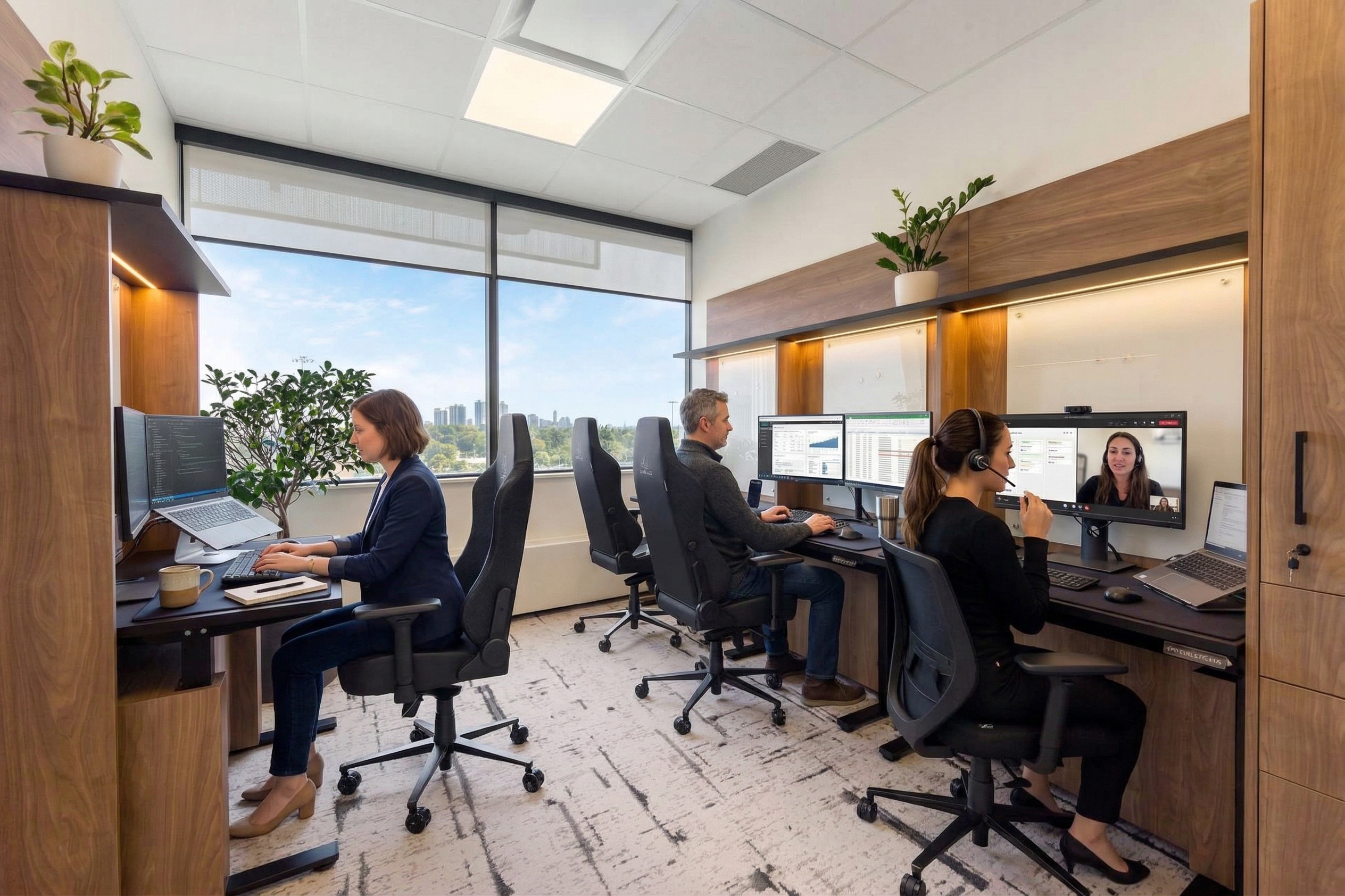
Most of the small business teams here are in one of two configurations: a cluster of dedicated desks in the open space, or a private office with the team's name on it and meeting rooms booked as needed.
The choice usually comes down to confidentiality and call volume. Teams that take a lot of calls or handle sensitive client information end up in private offices. Teams that mostly do focused work and meet clients occasionally do well with dedicated desks plus an hourly meeting room when they need one.
Both groups use the same kitchen, the same coffee, the same reception, the same front desk (which is me). The difference is whether they want their own door.
If you're considering it
The fastest way to know if coworking fits your team is to bring two or three of them in for a tour and let them sit in the space for an hour. Not a sales pitch. Just time in the room. You'll know within an hour whether your people will work here.
If you want to come through, book a tour and I'll show you around. Bring whoever on the team is going to be the most skeptical. Their reaction is the one that matters.
Tamar Gagnidze is the Community Manager at Jilani Place, a premium coworking space at 295 The West Mall in Etobicoke, where she leads member experience and day-to-day operations for solo professionals and small teams across the GTA.