
Meeting Rooms
Boardroom vs. Conference Room vs. Huddle Room: What's the Difference?

Tamar Gagnidze
Community Manager
Last updated
The short version: boardrooms are formal rooms built for 10 or more people making decisions that matter. Conference rooms are flexible mid-size spaces for general team and client meetings, usually seating 6 to 12. Huddle rooms are small rooms built for quick syncs and video calls, usually 2 to 6 people. The differences show up in size, AV setup, and how formal the room feels the second you walk in.
Most people I talk to at the front desk use these three terms interchangeably. And most of them book the wrong size room for the meeting they're actually having. Here's how to tell which one you need.
Quick comparison
| Room type | Capacity | Best for | Formality |
|---|---|---|---|
| Boardroom | 10 to 20+ | Board meetings, investor pitches, formal client presentations | High |
| Conference room | 6 to 12 | Team offsites, client kickoffs, training sessions | Medium |
| Huddle room | 2 to 6 | Standups, one-on-ones, video calls, candidate screens | Low |
That's the cheat sheet. The rest of this article is for figuring out which one matches the meeting on your calendar.
What a boardroom actually is
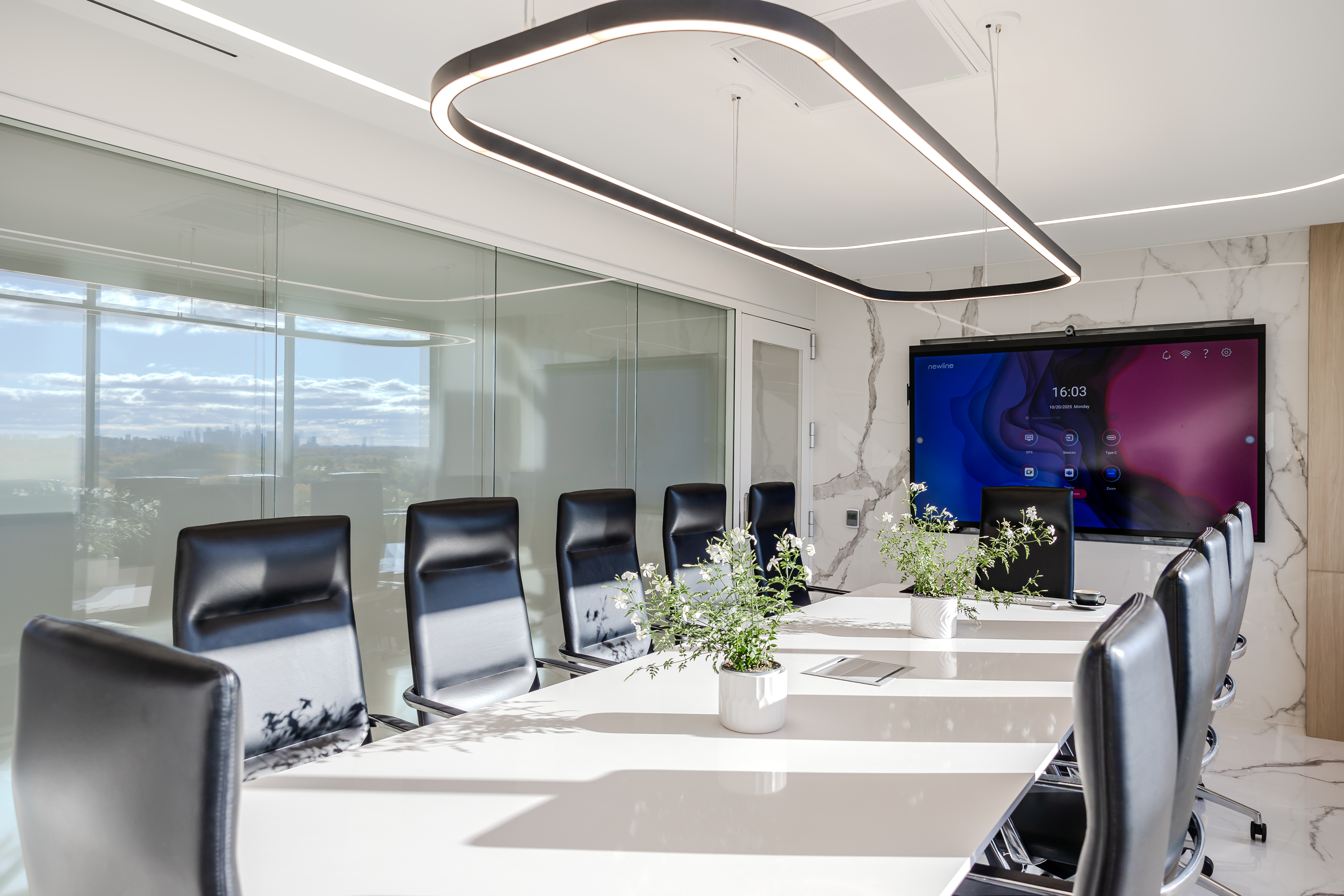
A boardroom is a room where the room itself is part of the message. Single large table, real chairs (not stackable folding ones), good lighting, premium AV, walls that don't echo when six people are talking at once. When a team books a boardroom for an external meeting, they're usually doing it because the conversation matters and they want the space to communicate that.
At Jilani Place we have two boardrooms. The Smart Boardroom seats 14 and gets booked for board meetings, investor pitches, and the kind of client presentation where you want a long table and a serious room. The Innovation Boardroom seats 10 and gets used for slightly smaller versions of the same thing, plus team strategy sessions where you need everyone in the same space with a whiteboard.
Boardrooms are not for your weekly team sync. If four of you are sitting at one end of a 14-seat table, the energy dies fast.
What a conference room actually is
A conference room is the workhorse of office meeting culture. Mid-size, flexible, less ceremonial than a boardroom. Most "meetings" people refer to in their calendars are technically conference room meetings: team offsites, client kickoffs, interviews with two or three people on a panel, training sessions, working sessions with a vendor.
Here's the honest part: at Jilani Place we deliberately don't have a traditional conference room. When we designed the space we looked at how our members were actually meeting and the middle category kept dropping out. Either teams wanted a real boardroom for something formal, or they wanted a small fast room for a video call or a quick conversation. The 8-person meeting in a generic mid-size room with cloth chairs wasn't the meeting most of our members were having.
So instead of a half-formal middle, we built two boardrooms (one bigger, one smaller) and a set of huddle rooms. If you need the boardroom feel for 8 people, the Innovation Boardroom does that. If you need a quick spot for 4 people to pop into, a Huddle Hub does that. The middle category turned out to be one most growing teams could skip.
If you're touring spaces and you see something labeled "conference room," ask what it actually fits and what the AV looks like. The label doesn't tell you much; the setup does.

What a huddle room actually is
Huddle rooms are the category most growing teams underuse. Small, fast, set up for video calls, easy to book for 30 minutes between other things. They're for the one-on-one with a direct report, the candidate screen, the focused working session for two people, the video call you can't take from your desk, the standup that doesn't need a giant table.
At Jilani Place we call ours Huddle Hubs and they seat 7, which is bigger than the typical huddle room. That was on purpose. Most of our growing business members were running team meetings of 4 to 6 people and a 4-seat huddle room was leaving them standing. A 7-seat Huddle Hub fits a real team meeting, fits a client video call with a couple of people on each side, and still feels appropriately small for a one-on-one.
The thing nobody tells you about huddle rooms: they get booked the most and asked about the least, because nobody knows what to call them. People come up to the front desk and say "do you have a small meeting room for an hour" and what they want is a huddle room.
How to actually pick
Three questions, in order:
- How many people? Under 6 is huddle territory. 6 to 10 could go either way depending on the second question. Over 10 is boardroom.
- Is this internal or external? Internal team meetings can almost always go smaller and less formal than people instinctively book. External meetings, especially with clients or investors, deserve a room set up to make a good impression.
- Do you need the room to feel formal? An interview with a senior candidate, a board meeting, a deal close, a pitch to a new investor: yes. A weekly team sync, a candidate phone screen, a working session: no.
A few real scenarios:
- Quarterly board meeting with 12 people: Smart Boardroom.
- Strategy offsite for your team of 8: Innovation Boardroom (the formality helps people take the day seriously).
- First meeting with a new client, 4 people total: Huddle Hub if they're casual, Innovation Boardroom if you're trying to win a contract.
- Weekly standup for a team of 5: Huddle Hub.
- Candidate interview, 1 hiring manager and 1 candidate: Huddle Hub.
- Investor pitch, you and 2 cofounders pitching to 4 investors: Smart Boardroom or Innovation Boardroom depending on tone.
The mistake I see most often
Teams default to bigger rooms than they need. The thinking is "I'd rather have extra space than be cramped." In practice, four people in a 14-seat boardroom have a worse meeting than four people in a room built for six. The energy spreads out, people stop leaning in, and the conversation goes flat.
If you're not sure, go smaller. A full huddle room feels productive. A half-empty boardroom feels like a meeting nobody really needed.
One last note
If you're trying to figure out what your team actually needs, the fastest way is to look at your last month of meetings and count how many had 4 or fewer people, 5 to 9, and 10 or more. Most growing teams I talk to are surprised by how heavily their meetings cluster on the small end. That's usually the answer about what to book most often, or what kind of room to look for if you're touring spaces.
If you want to come see the Smart Boardroom, the Innovation Boardroom, and the Huddle Hubs in person before you commit to anything, we're at 295 The West Mall in Etobicoke and you can book a tour.
Tamar Gagnidze is the Community Manager at Jilani Place, a premium coworking space at 295 The West Mall in Etobicoke, where she leads member experience and day-to-day operations for solo professionals and small teams across the GTA.