
Growing Businesses
How Much Does a Private Office Cost in Toronto?

Fahad Jilani
Founder, Jilani Place
Last updated
For a team of 5 in Toronto, a private office runs roughly $2,500 to $8,000+ per month. That's a 3x spread for what looks on the surface like the same product. The reason for the spread isn't arbitrary, and most teams I talk to are optimizing for the wrong variable when they shop.
Before founding Jilani Place, I spent years on the commercial real estate side at Jilani Group, watching landlords price space, watching tenants negotiate it, and watching what those leases actually cost once the buildouts and TMI surprises landed. That's the lens I bring to flex space pricing. What follows is how I'd think about it if I were running a 3-10 person team today.
The short answer, by team size
Some quick numbers to anchor the conversation. These are all-in monthly ranges for a private office in the GTA, covering rent, internet, furniture, cleaning, reception, utilities, and the basics that come bundled in a flex space. They reflect what you'd actually pay, not the marketing headline.
- Team of 3: $1,800 to $5,500/month
- Team of 5: $2,500 to $8,000/month
- Team of 10: $4,500 to $15,000/month
The low end sits in Etobicoke, North York, Mississauga, or older Class B buildings on subway lines. The high end is downtown trophy product like the Financial District or King West. The middle is everything else: Midtown, Liberty Village, suburban Class A.
If you're getting quoted outside this range, especially below it, ask what's missing. There's almost always something.
Flex office vs. traditional sublease: how to actually compare
This is the section most pricing articles skip, and it's the one that matters most for a growing team.
When you look at a traditional commercial lease in Toronto, the headline number is the net asking rent per square foot. In recent quarters, average net asking rents across the GTA have hovered around $52 per sq ft for trophy buildings, $27 for Class A, and $24 for Class B. Sounds reasonable until you do the rest of the math.
Avison Young pegs additional costs (property taxes, utilities, maintenance, the TMI line) at roughly 58% of net asking rent in Toronto. So a $25/sq ft Class B sublease is realistically $40/sq ft once you include TMI. For a 1,000 sq ft suite (roughly what a team of 5 needs at modern density), that's $40,000/year, or $3,300/month, before you furnish it, wire it, clean it, or hire someone to greet your clients.
Now add buildout. If the space isn't move-in ready, you're looking at $50 to $150 per square foot to furnish and finish a small office, depending on what's there. Even if the landlord covers half through a tenant inducement, you're often signing a 3 to 5 year lease to amortize that cost. The cheap per-square-foot number was hiding a long commitment and a big upfront cheque.
A flex private office at $5,000/month all-in looks more expensive on the headline. It's almost always cheaper for a team that might double in 18 months.
The variable that matters for a growing team isn't dollars per square foot. It's flexibility per dollar of commitment.
What actually drives flex office pricing
Within the flex category, four things move the price.
Location
Downtown trophy buildings carry a 40 to 60% premium over comparable suburban product. You're paying for the address, the lobby, and proximity to major transit. Whether that's worth it depends entirely on who walks into your office and how often.
Office configuration
Interior offices (no window) typically sit 15 to 25% below window offices in the same building. A 4-person enclosed room costs more per person than a 6-person room, because the per-square-foot fixed costs (door, walls, HVAC zone) get spread across fewer seats.
Term length
Month-to-month carries a 15 to 25% premium over 12-month commitments at most providers. A 24-month deal usually unlocks another 5 to 10%. If you're confident in your headcount for the next year, sign for a year. If you're not, eat the premium for the optionality. The premium is usually less than the cost of being wrong.
What's bundled
This is where the marketing gets murky. A "$3,500/month" private office at Provider A and a "$4,500/month" private office at Provider B can be the same total cost once you add the line items the cheaper quote excluded. Get the inclusion list in writing.
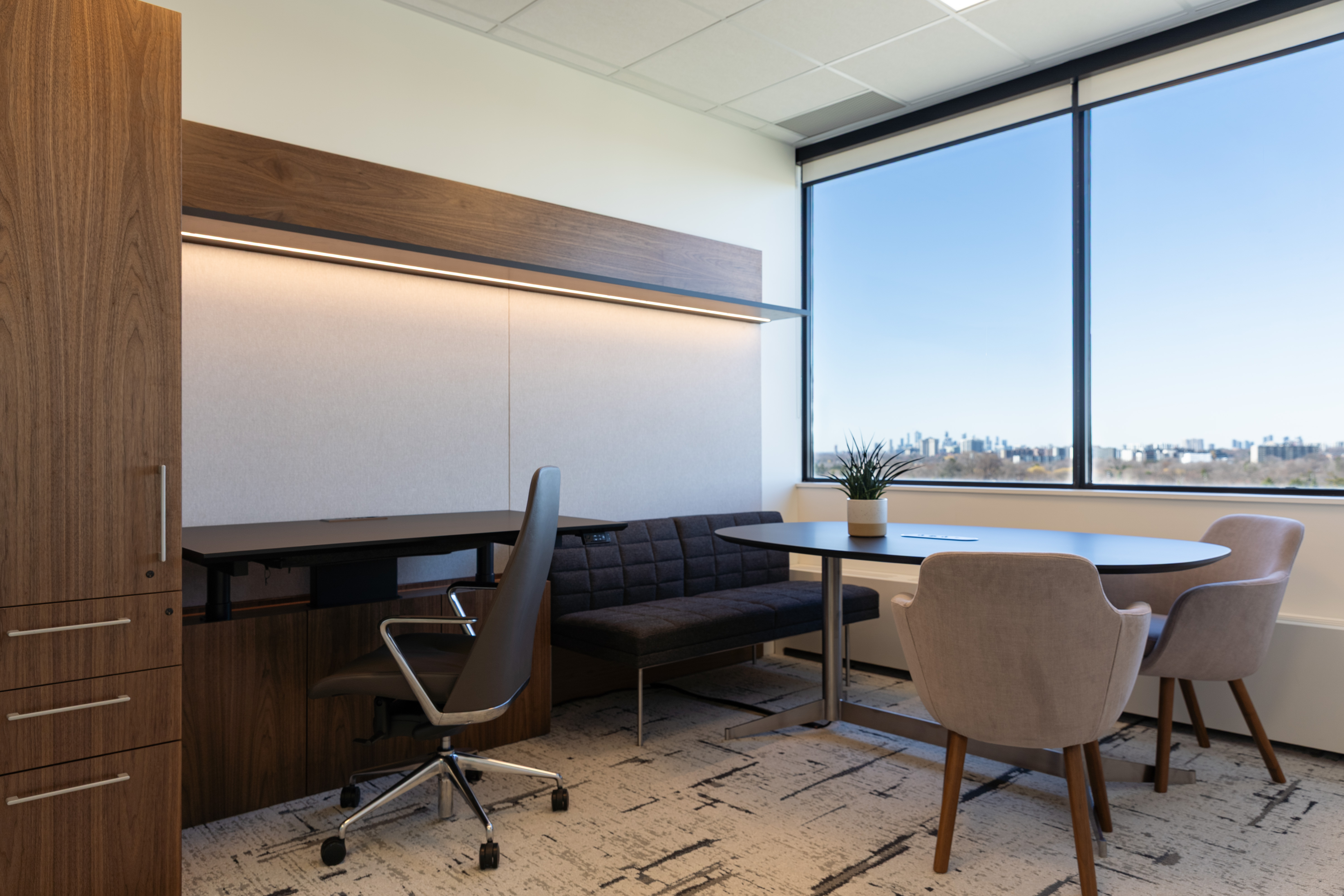
One thing worth saying explicitly before we get into tiers: location and quality are not the same variable. Most teams treat them as if they move together, so a downtown price feels like it must come with downtown finishes and a suburban price must mean a downgrade in everything. That's wrong. Operators outside the core have lower underlying real estate cost, which means they can put premium millwork, premium chairs, and premium infrastructure into the room and still price at the budget tier. The tradeoff you're making in the suburbs is the address, not the product inside the office.
Pricing by tier: what you actually get for a team of 5
Three realistic tiers for a 5-person enclosed private office in the GTA, with what's bundled at each.
Budget tier: $2,500 to $4,000/month
This price point splits into two genuinely different products, and most pricing articles miss the distinction.
The first is what most readers assume: older Class B buildings, downtown-adjacent flex providers, or interior offices in chains like Regus. Furnished, decent internet, basic meeting room access (usually capped at 4-8 hours/month), no full-time reception. Some buildings won't have a lobby presence at all, which matters more than people think when a client shows up. Parking is often paid separately. Coffee is the ground stuff, not the espresso machine. You're paying for proximity and accepting compromises on quality.
The second is suburban premium: independent operators in Etobicoke, North York, Mississauga, and similar markets, where lower underlying real estate cost lets the operator put premium millwork, motorized desks, ergonomic seating, business-grade infrastructure, and a real front-desk experience into a more compact footprint. A 5-person office at this end of the budget tier can be 130 to 180 sq ft (tight per-person), but the per-touchpoint quality often beats what you'd get at a downtown mid-tier provider. The tradeoff is density and address, not finish.
Both products live at the same price. They're not the same purchase. If you're touring at this tier, look at the chairs, the desks, the lobby, and the infrastructure before you look at the rate.
Mid tier: $4,000 to $6,500/month
This is where most growing teams in Toronto actually land, and where the same suburban premium operators move you up into a larger footprint (call it 200 to 300 sq ft for a team of 5, instead of the compact 130 to 180 you'd get at the entry price). It's also the price band for downtown Class B with a real lobby and Midtown Class A. Includes furnished space, business-grade internet (ideally with redundancy), 15 to 30 hours of meeting room access, a staffed front desk during business hours, mail handling, kitchen with decent coffee, printing, and 24/7 access. Examples include independent operators in Etobicoke, North York, and Liberty Village, plus Workplace One and Workhaus locations outside the financial core.
This tier is the sweet spot for a team of 5 with regular client meetings, occasional candidate interviews, and enough room to spread out for heads-down work.
Premium tier: $6,500 to $10,000+/month
Downtown Class A or trophy product. WeWork, iQ Offices, Industrious in the Financial District. Industrious Toronto Financial District lists team space starting at roughly CA$14,280 per month, and that isn't the top of their range. Includes everything in the mid tier plus prestige address, full-time concierge, premium meeting rooms with AV setups, event space access, and (often) a global network of locations included.
This tier is worth it when your client base is downtown and your address is part of how you sell. It's a stretch when your team is mostly heads-down work and your clients are remote.
Line items most quotes leave out
Even within flex pricing, the headline number frequently excludes:
- Parking. Downtown stalls run $300 to $500/month. Suburban is often free or under $100. For a team of 5 with even two regular drivers, this is real money.
- After-hours and weekend access. Some providers charge for keycard access outside 7am to 7pm.
- Guest passes beyond the included quota. If clients visit weekly, the overage adds up.
- Additional desks mid-term. Hire a 6th person? Some operators charge a per-seat add-on; others require you to upgrade the whole suite.
- Meeting room overage. 30 included hours sounds like a lot until you actually run a sales team.
- Phone booth access in some providers' models.
- Mail handling and registered address use.
I tell every prospective tenant the same thing: the comparison number that matters is the all-in monthly cost at your expected usage, not the starting rate on the website. Build the spreadsheet. The rankings will shift.
How to think about total cost of ownership
The thing growing teams chronically underweight is the cost of being wrong about your headcount.
A 3-year lease at $4,500/month is $162,000 in commitment. If you grow to 8 people in 18 months and need to move, you're either paying for two offices or buying out the lease. If you grow slower than expected and shrink to 3 people, you're paying for empty desks. Either way, the "cheaper" lease became expensive.
A flex office at $5,500/month with a 12-month term is $66,000 in commitment, with the option to renegotiate or upgrade after a year. The premium of $1,000/month over the cheaper sublease (call it $12,000/year) is buying you the right to be wrong about the future.
Here's how a worked 18-month comparison usually shakes out for a 5-person team. Take a 1,000 sq ft Class B sublease at $25/sq ft net. Add 58% TMI and you're at $40/sq ft, or $40,000/year. Add $50,000 in buildout (split landlord/tenant, so $25,000 of your money), $15,000 to furnish, $5,000 in legal and project management, $3,500/year for cleaning, $4,800/year for internet, plus the time cost of managing all of it. Over 18 months you're at roughly $115,000 of real cost, locked into a 5-year obligation, with no easy path to grow or shrink.
Compare that to a flex office at $5,500/month with a 12-month term, everything bundled. Eighteen months is $99,000. No buildout cheque, no furniture, no internet contract, no cleaning vendor, no project to manage. If you grow at month 9, you upgrade to a bigger suite. If you shrink, you don't renew. The flex office costs less in total, takes zero of your time to operate, and doesn't tie you to a building that might not fit you in 2028.
For a stable team in a mature business that knows its 3-year footprint, traditional leases still win on price. CBRE forecasts national net absorption of 5.1 million sq ft in 2026, with over half of that in Downtown Toronto, and landlords there are pricing accordingly. But for a growing team, the optionality premium is one of the better deals in the Toronto office market right now.
A note on Etobicoke and the rest of the suburbs
The suburban story in Toronto right now is interesting. CBRE's Q1 2026 figures put suburban GTA office vacancy at 21.0%, slightly higher than the previous quarter. CBRE also expects that gap to compress as tenants increasingly favour shorter commutes and better amenity packages over downtown prestige. Translation: tenants have leverage in the suburbs, and good product is starting to look like a better deal than equivalent downtown space.
For a growing team, a few things make Etobicoke and the inner suburbs worth a serious look.
Most growing teams have at least one or two people commuting from the 905. A central Etobicoke address splits the difference between downtown and Mississauga without putting anyone on a 90-minute commute. Parking is usually free or cheap, which functionally adds a few thousand dollars of annual compensation per driving employee. Client meetings have largely moved to video, so the downtown address premium pays off less than it used to. And the pricing spread is real: a team of 5 paying $5,000/month in Etobicoke is buying roughly the same product that costs $7,500/month downtown.
Paul Rockwell, who runs Blitzscale Broker out of Jilani Place, ran exactly this calculation before signing. He could have been in a King West Class A flex space for not dramatically more, but his clients are mostly Zoom anyway, and the parking math alone moved the needle.
Sometimes downtown still wins. When the partners are in BMO Tower and the candidates need a 5-minute walk from Union, the address premium is a real revenue lever. When the team is mostly remote-first with a mid-week colocation rhythm, the suburban math is hard to argue with.
Run your own numbers
If you're pricing private offices for a growing team, the most useful thing isn't another listicle. It's running your own numbers against a real space with a real quote that includes everything. Come tour Jilani Place, get a quote with no surprise line items, and compare it against whatever else is on your shortlist. Details and pricing are at jilaniplace.com/private-offices.
The right office for a growing team is the one whose total cost matches your actual usage, with enough flexibility to be wrong about next year. Start there.
Fahad Jilani is the Founder of Jilani Place.