
Private Offices
How Much Office Space Do I Need for a Team of 5?

Fahad Jilani
Founder, Jilani Place
Last updated
For a team of 5, the standard answer is 750 to 1,250 square feet. That number is wrong for most teams I talk to, and the reason has nothing to do with hybrid work. It's wrong because it bundles two completely different things into one number, and once you separate them, the same 5 people can work productively in 130 square feet.
I know that sounds like a stretch. We've built it. People are using it right now. I'll show you the math.
The fast answer
If you're signing a direct commercial lease for a team of 5, plan for 750 to 1,250 square feet. That gets you workstations, a meeting room, a kitchenette, some storage, circulation space, and a reception or waiting area if you want to look professional to clients.
If you're taking a private office inside a coworking space, the same team of 5 fits into 130 to 250 square feet of private space, plus shared access to meeting rooms, a kitchen, a lounge, phone booths, and whatever else the building offers. At Jilani Place, our two 5-person configurations are exactly that: a 250 square foot executive layout for teams that want breathing room, and a 130 square foot dense layout for teams that just need a focused home base.
Both numbers are correct. They're answering different questions.
Where the 150 square foot per person rule comes from
The "150 to 250 square feet per person" rule has been the default planning number in commercial real estate for decades. It's roughly accurate if you're designing a self-contained office that holds everything your team does in a workday. The problem is that nobody ever opens up the number to look at what's inside it.
When you break it down, the per-person figure splits into two parts.
The workstation itself, which is small. A standard desk plus chair plus a bit of elbow room is somewhere between 25 and 50 square feet per person. That's the part that scales linearly with headcount.
Everything else, which is most of it. Meeting rooms, circulation corridors, kitchen, washrooms, reception, storage, mechanical and electrical rooms, that one weird corner nobody uses. This part doesn't really scale with headcount. You need a meeting room whether your team is 3 or 8. You need a kitchen whether you have 4 employees or 12.
So when a planner tells you "200 square feet per person, so 1,000 square feet for 5," they're really telling you "250 square feet of workstation plus 750 square feet of shared infrastructure." The shared infrastructure piece is most of your rent.
That's fine if you actually want a self-contained office. It's wasteful if you don't.
The two questions to actually ask
Before you sign anything, answer these two questions honestly.
How much focused work space does each person need? For most knowledge work, the answer is a desk, a chair, two monitors, decent lighting, and quiet. That's 25 to 50 square feet per person, not 200.
What supporting infrastructure does the team need access to, and does it have to be inside your four walls? Meeting rooms, a kitchen, a lounge, phone booths, mail handling, reception, parking. You absolutely need these things. The question is whether you need to own them or whether you can share them.
If you can share, your private footprint shrinks dramatically. If you can't, you're back to the 750 to 1,250 square foot range.
For the vast majority of 5-person teams I've seen, the honest answer is they can share. They book one or two meeting rooms a week. They don't have a dedicated receptionist. They reheat lunch in a microwave. None of those functions need to live inside their lease.
Three scenarios for the same 5 people
Let me walk through what 5 people actually look like in three different setups.
Scenario A: Self-contained direct lease
You sign a 1,000 to 1,250 square foot lease in a Class A or B building. Inside, you fit five workstations, one meeting room for 6, a small kitchenette, a closet for storage, and a reception area. Everything your team needs is inside that footprint. You're paying for all of it, all the time, including the meeting room you use four hours a week and the kitchen that sits empty 90% of the day.
Scenario B: Executive private office in coworking, 250 square feet
Five people in a 250 square foot room with proper desks along a window wall, ergonomic chairs, integrated millwork for storage, and enough room to push your chair back and stretch. You step out for meetings (booked through the building), step out for lunch (kitchen down the hall), step out for video calls (phone booths or one of the meeting rooms). The room is for focused work and quiet team conversation. Everything else happens elsewhere in the building.
Scenario C: Dense private office in coworking, 130 square feet
Same five people, same workflow, smaller room. Continuous bench desking against a window wall, ergonomic chairs, vertical storage built into millwork, glass markerboards for quick whiteboarding. The room is tighter. It's also genuinely usable, because the rest of the building absorbs the functions a tighter room can't host.
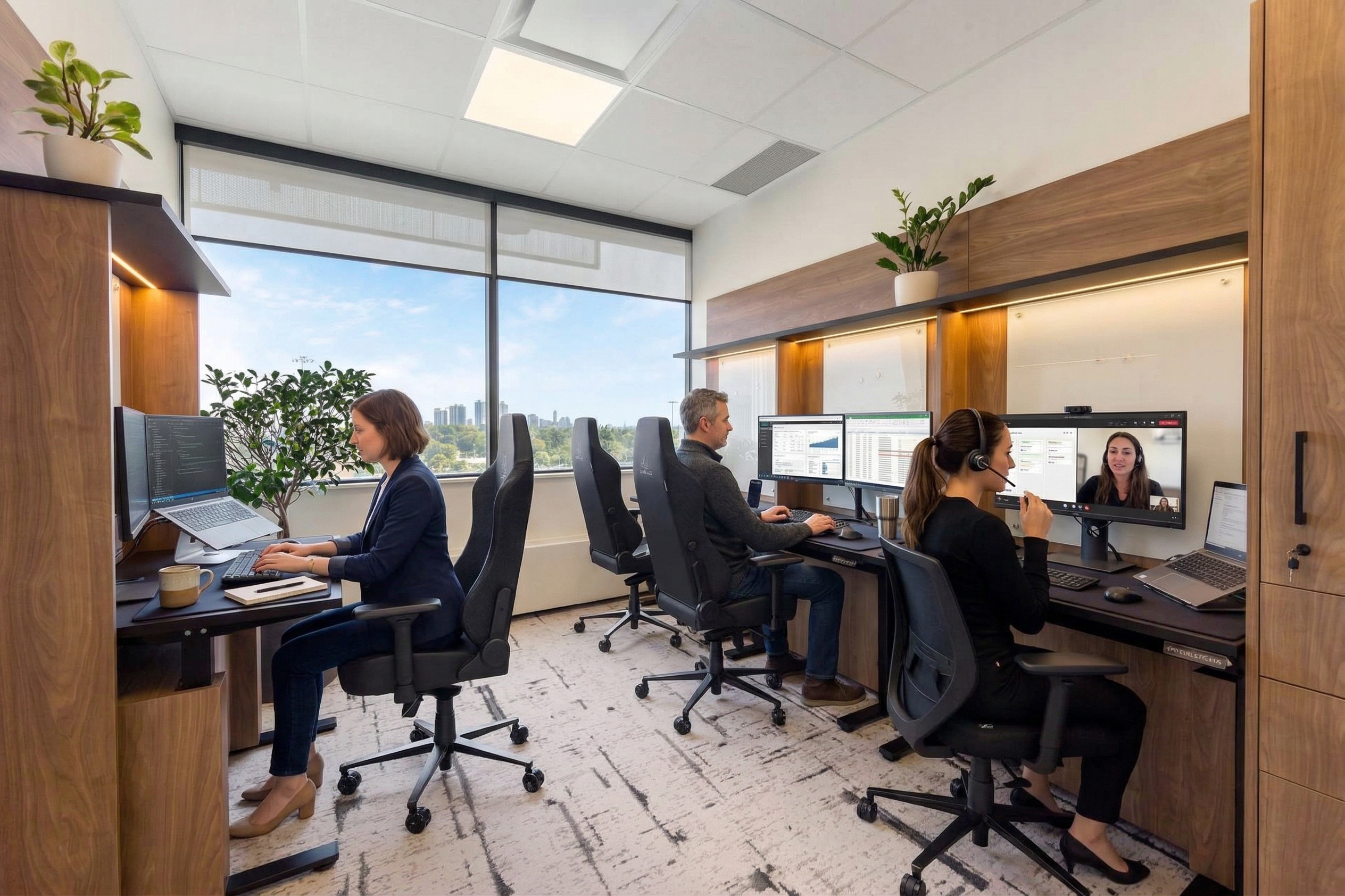
The photo above is our 130 square foot configuration. Five chairs, five desks, daylight, storage, a writable surface. That's what 26 square feet per person looks like when the building does the heavy lifting on everything else.
What you give up at 130 square feet, and what you don't
I'm not going to pretend the dense layout is for everyone. Here's what you actually trade off.
You give up the ability to take a video call without leaving the room. Five people on five different Zooms in 130 square feet is a nightmare. You use phone booths instead. We have several.
You give up casual side conversations. If two teammates need to hash something out, they go to the lounge or grab a huddle room. You can't have a side meeting in the corner of a 130 square foot room without disrupting everyone.
You give up storage volume. The millwork helps, but if your business runs on physical inventory, paper files, or sample products, you'll outgrow it.
You give up the option to have a client visit your private office and feel impressed. For client meetings, you book a proper meeting room. The private office isn't where you host.
Here's what you don't give up: focus, ergonomics, daylight, internet quality, or air. Those are the things workplace research consistently points to as productivity drivers, and they're all present in the dense layout. Perceived control over noise and reliable access to quiet space matter more than raw square footage. As long as the building gives you somewhere to escape to, the private room can be smaller than convention says.
What this actually costs in Etobicoke
Now the financial side, which is what most people are really asking about when they ask how much space they need.
A direct lease for 1,000 square feet in a decent Etobicoke office building (think the West Mall corridor, Sherway, Islington corporate centre) typically runs in the range of $28 to $42 per square foot per year all-in, when you combine net rent and additional rent (TMI). Call it $30,000 to $42,000 a year just for the space.
Then add the costs that don't show up on the lease:
- Fit-out: at minimum $50 per square foot for a basic build (paint, flooring, partitions, electrical), often $80 to $150 if you want anything decent. On 1,000 square feet, that's $50,000 to $150,000 up front.
- Furniture: $1,500 to $4,000 per workstation, plus meeting room, kitchen, reception. Realistic spend is $20,000 to $40,000 for a team of 5.
- Business-grade internet with redundancy: $3,000 to $8,000 a year.
- Insurance, cleaning, utilities (if not bundled into TMI), waste, supplies: another $8,000 to $15,000 a year.
- Lease term: most landlords want 5 years minimum for a small tenant. You're locked in.
All in, year one for a self-contained 1,000 square foot office runs comfortably north of $100,000 once you account for capital and operating costs. Year two onward settles around $50,000 to $65,000 a year, assuming nothing breaks.
A private office for 5 people inside a coworking environment, by comparison, is typically a single monthly fee that covers the room, internet, utilities, cleaning, kitchen, reception, mail handling, and a baseline amount of meeting room usage. In Toronto, that lands in the $2,500 to $5,500 per month range depending on building, location, and room size, with no fit-out cost and no five-year commitment.
The all-in math usually favours coworking until the team hits 8 to 10 people. Past that point, the per-person economics flip and a direct lease starts to win.
When direct lease actually wins
I want to be honest, because the contrarian framing only goes so far. Coworking isn't always the right answer. Here's when a direct lease genuinely makes sense for a team of 5:
You have a client-facing business where the office is part of the brand. You work in a regulated industry that requires controlled environments, secure document handling, or restricted access. You have specialized equipment that won't fit in a standard office (a lab, a studio, a workshop). You're confident you'll be 12 to 15 people within 18 months and you'd rather size for that now than move twice.
If none of those apply, the math almost never works under 10 people. I've watched it go wrong enough times to feel strongly about this.
A note from the commercial real estate side
Before Jilani Place, my work was on the landlord side through Jilani Group, our family's commercial real estate business. I've sat in the meetings where small teams sign leases they shouldn't sign. The brokers are well-meaning. The landlords are happy. Nobody at the table has a financial incentive to ask whether the tenant actually needs 1,000 square feet, or whether they could be happier and more profitable in 250.
That gap is part of why we built Jilani Place. Both the 250 square foot executive room and the 130 square foot dense room exist because real teams of 5 wanted them. One team picked the executive layout because they wanted space to grow and the optics of a roomier office. Another team picked the 130 square foot room because they're focused on minimizing fixed costs while they scale. Neither team is wrong. They're answering different questions.
So how much do you actually need?
If you take one thing from this article, take this: the question isn't how much office space your team of 5 needs. The question is how much private office space you need, given what you're willing to share. The answer to the first question is 750 to 1,250 square feet. The answer to the second is somewhere between 130 and 1,250 square feet, and most teams land closer to the bottom of that range than the top.
If you want to see what 130 square feet versus 250 square feet actually feels like for 5 people, come tour both. Sit in the chairs. Walk to the meeting rooms and the kitchen and the phone booths. Decide which version your team would actually use day to day. The right answer is almost never the one you pick from a spreadsheet.
Fahad Jilani is the Founder of Jilani Place.