
Growing Businesses & Enterprise
Signs Your Team Has Outgrown Coworking

Fahad Jilani
Founder, Jilani Place
Last updated
I created a coworking space. I also run a commercial real estate firm (Jilani Group), which is why I'm one of the few people who'll actually tell you when to leave coworking instead of pretending it fits forever. Below are the clearest signs your team has outgrown the model, in roughly the order they show up, plus the inflection point most founders miss before they sign a lease they didn't need.
A note on framing before I get into it. Most "is it time to leave coworking" articles are written by people who only sell one product. If you only sell lease space, every team has outgrown coworking. If you only sell coworking, no team ever does. I sell both. So I'll give you the honest version, including the part where the right answer is to stay put a little longer.
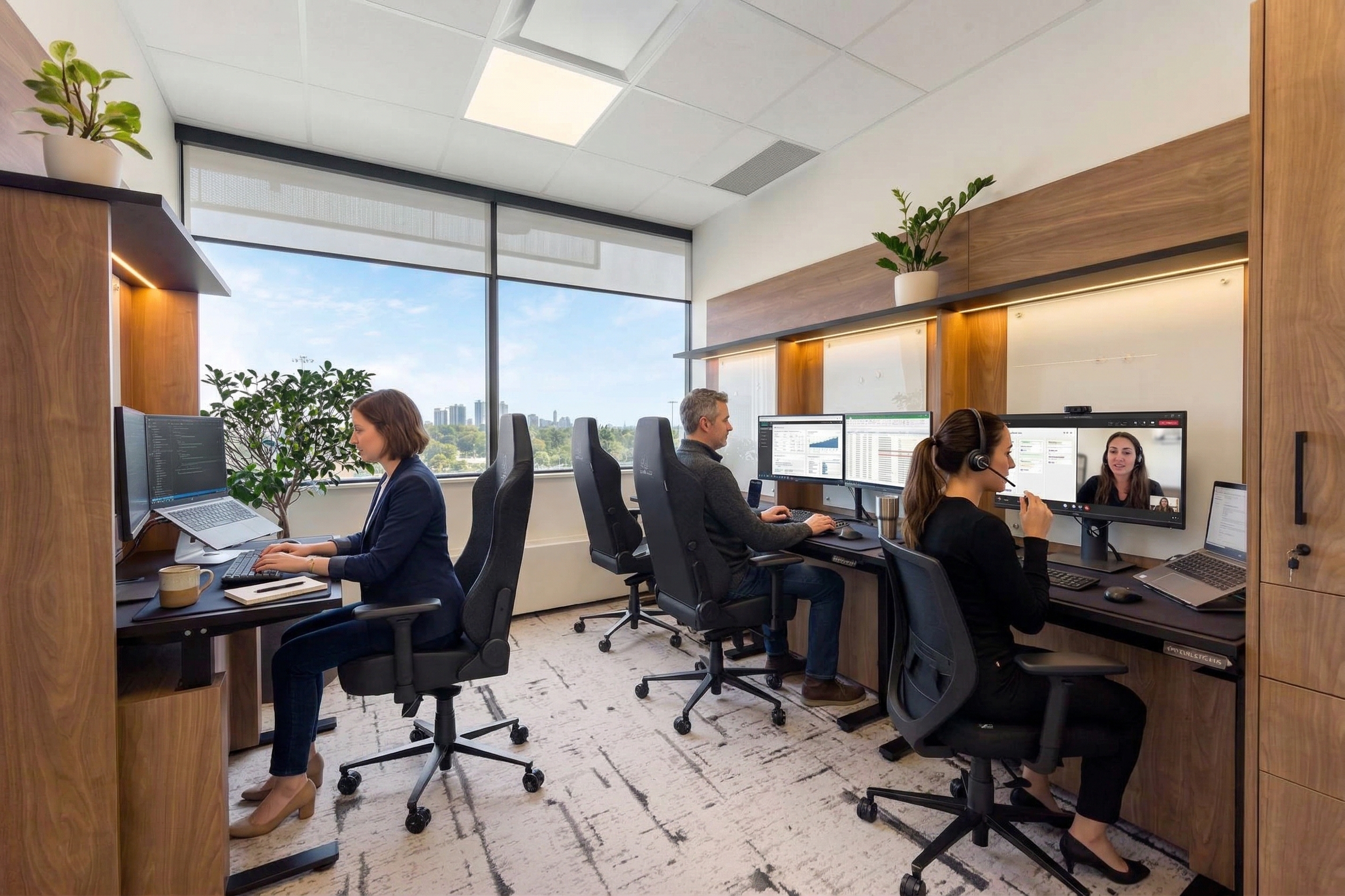
1. You're booking meeting rooms more than 8 hours a week
This is the cleanest leading indicator. Most coworking memberships include a small meeting room allowance per month. Once your team is consistently spilling past that, the math gets ugly fast. Eight hours a week is roughly thirty-two hours a month, and at that point you're paying for a meeting room you don't own, can't decorate, and might not get when you need it.
The deeper problem isn't the cost. It's the friction. When your team has to negotiate calendar Tetris every time someone needs to take a sensitive call or run a workshop, you start avoiding meetings you should be having. Decisions get pushed to Slack. Onboarding gets shallower. Junior people stop asking the questions they should be asking out loud.
If you're hitting eight hours weekly and growing, you don't necessarily need a private office. You need a private team room, which is a different thing (more on that below).
2. Your team has stopped having unscheduled conversations
This one is harder to notice because it shows up as an absence. The "hey, can I show you something?" moment that's the actual reason teams co-locate stops happening.
There's real research behind this. MIT's Thomas Allen mapped the relationship between desk distance and communication frequency in the 1970s, and the finding has held up through every replication since. Communication drops sharply as distance increases and essentially flatlines at about 8 meters (roughly 26 feet). At that point, the probability of two people communicating at least once a week falls to just 5%. Digital tools haven't fixed this. Studies by Ben Waber found that engineers who shared a physical office were 20% more likely to stay in touch digitally than those who worked elsewhere. When they needed to collaborate closely, co-located coworkers e-mailed four times as frequently as colleagues in different locations, which led to 32% faster project completion times.
A 2017 meta-analysis covering nearly 10,000 teams sharpened the point. In-person teams demonstrate a communication-to-performance link that's three times stronger than fully virtual teams.
In a coworking space using hot desks, your team can't sit together. With dedicated desks, they probably can, but if the desks aren't clustered, the curve still gets you. Once your team has crossed the threshold where they're texting each other in the same building because it's faster than walking over, you've outgrown the format. That's the moment to either cluster aggressively (talk to your community manager) or move to a private team room.
3. You're handling sensitive information in semi-public space
Client data, financial models, hiring conversations, performance reviews, legal review, M&A material. None of this belongs on a hot desk floor.
I see this constantly through the commercial real estate side of my business. Founders running professional services firms (legal, financial, healthcare-adjacent) hit this wall not because someone is actively eavesdropping, but because they realize they're one open laptop away from a privacy incident they'd have to disclose. Their clients expect a baseline of confidentiality that an open floor can't offer.
This isn't a paranoia argument. It's a basic professional standard. If a quarter of your team's daily work involves information you wouldn't want a stranger to see or hear, you've outgrown an open coworking floor. You may not have outgrown coworking entirely (a private team room solves this), but you've outgrown the open desk format.
4. You've added a third hire in the last six months
Hiring velocity is the strongest predictor of when the economics flip. Coworking math is excellent at three desks. It's break-even around six. By nine it's usually worse than a small private office in most Toronto submarkets, depending on how you account for the things coworking includes for free.
Let me show you the actual numbers, because most "coworking vs private office" cost comparisons online are written by people selling one or the other. According to TRREB, the average office lease rate in the GTA reached $20.84 per square foot in Q2 2025, up from $17.55 the prior year. Etobicoke specifically is running in a similar range; I'm seeing listed asking rates around $19 per square foot net for general office product. On top of net rent, you're paying TMI (taxes, maintenance, insurance), which in this market typically adds another $14 to $18 per square foot.
So a 1,000 square foot office in Etobicoke (which holds about seven to ten people at standard density) is running roughly $33 to $37 per square foot gross, or about $2,800 to $3,100 monthly for the space alone. Then you add utilities, business internet, furniture (amortized over the lease), cleaning, coffee, water, supplies, and someone's time managing all of it. Realistically you're at $4,500 to $5,500 a month all-in for a 1,000 square foot office, before any buildout costs.
Compare that to nine dedicated coworking desks at GTA rates, which might run $4,000 to $5,500 monthly with everything included. The per-seat cost is closer than people assume. Coworking is still genuinely cheaper at small headcounts because there's no lease commitment, no fitout, no furniture spend, and no time tax on the founder. The crossover happens later than most operators want you to believe and earlier than most coworking spaces will admit.
The Toronto context matters here too. National sublease space has declined for an 11th consecutive quarter, and Toronto led the decrease once again. Vacancy in Class A trophy assets is currently under 10.0% for the first time since 2020. What this means practically: if you're considering a private office in a desirable building, the window of soft pricing and generous tenant inducements is closing. Toronto's downtown vacancy rate fell to 14.4% from 18.3% a year ago. Etobicoke and the rest of the suburban West isn't moving at the same pace, but it's also not getting cheaper.
If you've added three people in six months and you expect to add three more in the next twelve, run the math now, not the day you hit twelve heads.
5. Clients are visiting and you're apologizing for the setup
When you bring a client to a coworking space and the first thing out of your mouth is some version of "sorry, this isn't really our office," you've outgrown coworking for client-facing purposes. It doesn't matter how nice the space is.
Independent professionals can borrow credibility from a premium coworking lobby. A solo consultant or fractional executive looks more established hosting a client meeting at a well-designed coworking address than they do at a coffee shop or their kitchen table. That math reverses for teams. Once a client has met three of your people in three different corners of the floor (someone hot-desking, someone on a phone booth call, someone at the kitchen), they're not assembling a coherent picture of your company. They're assembling a picture of a company without a real office.
If your sales motion involves clients visiting (true for professional services, agencies, design firms, M&A advisory, anyone selling expensive judgment), the cost of looking unsettled is real and unmeasured. You won't see it in your CRM. You'll see it as a slight elongation of close cycles you can't quite explain.
6. You want to control the environment
This one is fuzzy but real. At some headcount you stop wanting to be a guest in someone else's space. You want your own coffee, your own art on the walls, your own Slack standup on the TV, your own culture seeping into the room. You want a place that feels like the company.
I won't pretend this is a financial argument. It's an identity argument. But identity matters for retention, recruiting, and the founder's own sanity. If you find yourself frustrated that the music isn't quite right, or that you can't put up the company logo, or that you have to take down whiteboard work at the end of the day, the friction is telling you something.
The middle path most founders miss
Here's the part where the standard "is it time for a private office" article skips over the cheaper, lower-risk option. Most premium coworking spaces (including Jilani Place) offer dedicated team rooms inside the broader coworking floor. You get a private, lockable space for your team. You keep the meeting rooms, kitchen, reception, internet, cleaning, and coffee that come with the membership. You skip the lease, the buildout, the furniture spend, and the time cost of running an office.
Team rooms work for teams of three to roughly ten, depending on the room. They handle five of the six signs above:
- Meeting room overflow stops being a problem because most internal conversations happen in your room.
- Unscheduled conversations come back because everyone is in the same place.
- Sensitive information has somewhere to live.
- Client visits have a real "your office" to land in.
- Environment control is partial but meaningful (your art, your whiteboards, your stuff).
The one thing a team room won't fix is hard headcount scale. Once you're past about ten people, room geometry stops working and you're back to looking at private office space.
For most growing teams I see, the right move is a team room for twelve to twenty-four months while you figure out whether your business is going to keep growing at the rate that justifies a lease. If it does, you'll know, and you can move out of the team room directly into private space (often with the same operator, often without breaking continuity for your team). If growth flattens, you've saved yourself a lease commitment and a buildout you'd have regretted.
When you actually do need to leave
A few situations where the team room middle path doesn't work and you should be looking at a private lease:
Headcount above twelve to fifteen
Geometry runs out. You need multiple rooms, your own kitchen capacity, your own washroom ratio, and dedicated infrastructure that coworking spaces aren't built to provide.
Multi-year horizon with revenue certainty
If you have three-plus years of contracted revenue or a similar runway picture, the lease commitment risk is lower and the per-seat economics start favouring private space, especially in suburban submarkets like Etobicoke and Mississauga where you can get reasonable rates per square foot.
Specialized buildout
Recording studios, lab space, secure server rooms, hardware prototyping benches, anything that requires permanent infrastructure. No coworking space is going to wire your floor for the build you actually need.
Satellite presence for a larger company
This is the L'Oréal Canada model: a multinational using a flexible space as a satellite footprint while their main corporate office is elsewhere. It works, but the use case is different from a growing startup, and the procurement process is too.
Brand-defining real estate
Some businesses (luxury, hospitality, experiential) need the address itself to do work. If your office is part of your marketing, coworking won't get you there.
How to actually evaluate the move
If you've worked through the signs above and you think you're at the inflection point, here's the framework I use with clients on the brokerage side. It's deliberately unsexy.
Total monthly cost, fully loaded
Rent plus TMI plus utilities plus business internet plus furniture amortized over the lease term plus cleaning plus coffee and supplies plus reception or phone answering plus the time cost of whoever is going to manage the office. Most founders compare base rent to coworking and miss half the line items.
Commute impact on retention
If you move from a central coworking location to a more affordable suburban office, calculate what the average added commute time costs you in turnover risk. The Toronto labour market is competitive enough that a 25-minute commute change can move someone's job hunt timeline forward by a year.
Lease length versus business certainty
A five-year lease is a five-year bet on your business model, your headcount projection, and the submarket. If you wouldn't bet that confidently on any of the three, the lease is too long. Look for shorter terms (three years with renewal options is more common than founders realize) or stay in flexible space until you have the certainty.
CEO time spent managing an office
Plumbing, internet outages, cleaning vendor issues, furniture deliveries, key fobs, mail, building access disputes. None of this is on your skill tree. Estimate ten to fifteen hours a month of founder or ops-lead time minimum. Apply your own hourly cost to that.
If the fully-loaded number still favours a private office and you can stomach the lease horizon, move. If it doesn't, or if the answer is close, stay in flexible space and revisit in six months.
A short note on Etobicoke specifically
Most of the founders I see hitting these signs are doing so in coworking spaces downtown, where the per-desk cost is high and the commute pulls people in. Etobicoke is a credible alternative for teams that have outgrown a downtown coworking space but aren't ready for a private lease. The submarket has the office product, the highway access, the lower cost basis, and (this part is local bias) we built Jilani Place specifically for the team-room middle path I described above.
If your team is in the eight-to-twelve range and you're starting to ask whether it's time to leave coworking, come tour the dedicated team rooms before you assume the answer is a lease. If after the tour the answer really is a private office, I run the company that can help you find one. But come see what the middle path looks like first. Most growing teams discover they have another year of runway in a team room before they actually need to be on a lease, and that year tends to be the one where their business clarifies enough to know what kind of office they really need next.
Fahad Jilani is the Founder of Jilani Place.