
Coworking & Private Offices
Do Coworking Spaces Have Private Offices?

Tamar Gagnidze
Community Manager
Last updated
Yes, most modern coworking spaces have private offices. The confusion is fair though, because the word "coworking" used to mean one thing (a big shared room with open desks) and now covers a whole spectrum of workspace types under one roof. I get this question almost every week at the front desk of Jilani Place, usually from someone who has been working from home for a couple of years and assumed coworking meant giving that privacy up.
It doesn't. But the answer is more nuanced than just "yes," because not every coworking space offers the same tiers, and the term "private office" can mean very different things depending on where you walk in. Here's how to make sense of it.
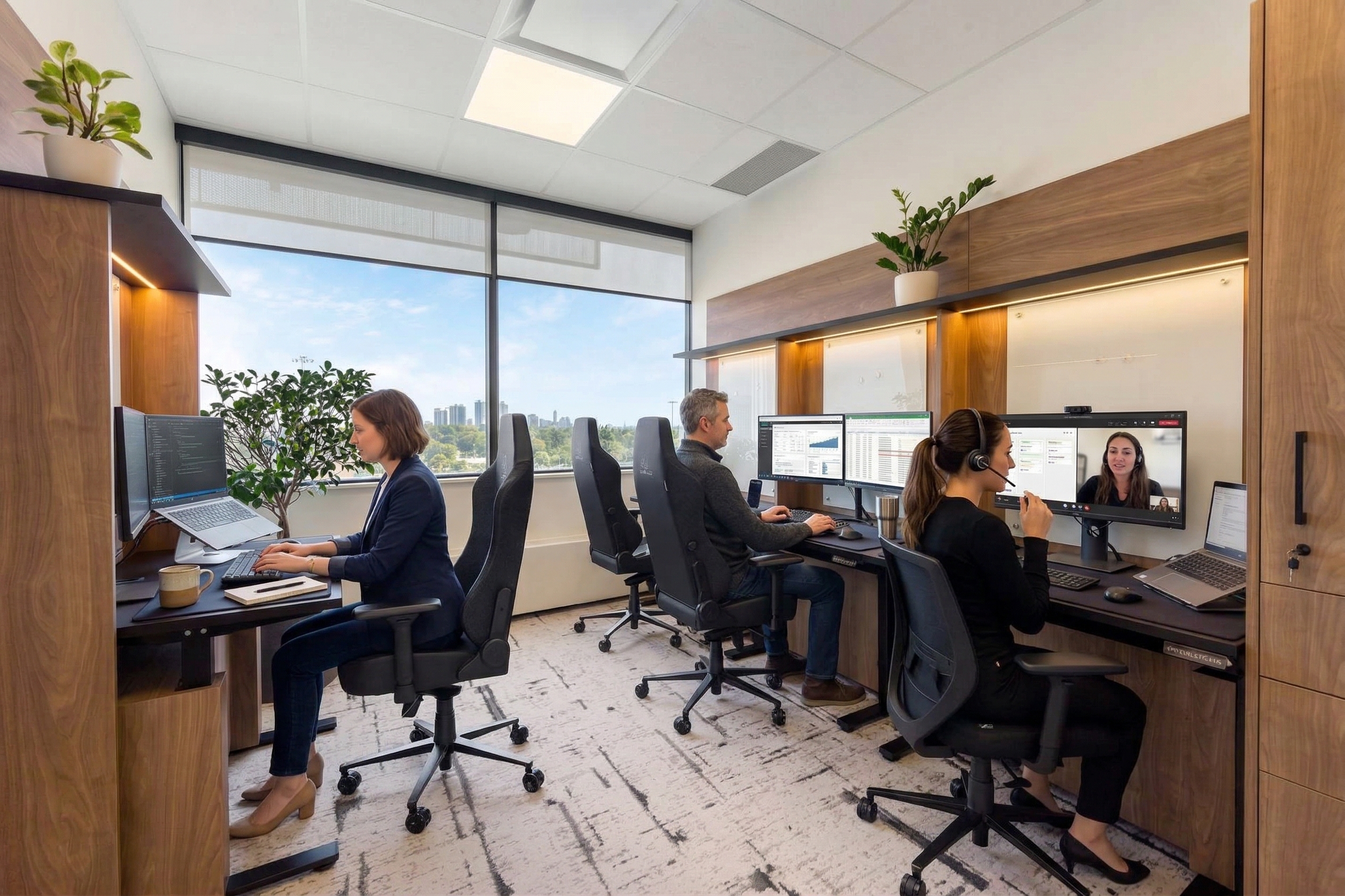
The privacy tiers you'll find in a typical coworking space
Most coworking spaces in Toronto and the GTA are organized into four tiers, and which ones a space offers is the real answer to your question.
Hot desk
A shared workspace where you grab whatever seat is open that day. You bring your laptop, plug in, work, leave. No assigned spot, no storage. Best for people who only come in once or twice a week, or are testing whether coworking suits them. In Toronto, monthly hot desk memberships generally run between $200 and $400.
Dedicated desk
Your own permanent desk in a shared room. Same chair, same monitor setup if you want one, often a locking pedestal for your files. You're still in an open environment, but you have a spot that's yours. Toronto pricing typically lands between $400 and $700 a month.
Private office
A room with a door that closes and locks. One desk, two desks, sometimes four, depending on the office. This is what most people actually picture when they imagine "having an office," and yes, almost every full-service coworking space includes them in their inventory. Pricing varies widely, but expect $800 to $2,500 a month in Toronto for a one to four person office.
Team suite
A larger private office or a connected set of rooms, usually for teams of five to ten or more. Some spaces offer these, some don't. Pricing is essentially custom at this size.
The reason this matters: when someone asks me "do you have private offices?" they're often surprised to learn that yes, we have several, and that the people who use them aren't fundamentally different from the people working at the hot desks. A lot of our private office members actually started on a dedicated desk and moved up when their work shifted (more client calls, more confidential material, a business partner joining them).
What "private office" actually means inside a coworking space
This is where the second piece of confusion shows up. People sometimes hear "private office in a coworking space" and picture a glass cubicle in the middle of a noisy room. That's not what it is.
A private office in a real coworking space is a real office: solid walls, a door that locks, a window if you're lucky, your own desk and storage. What makes it a coworking private office (rather than a leased commercial office) is what's around it.
You still share the kitchen, the lounge, the meeting rooms, the reception, the internet, the printing, the coffee. You don't pay separately for any of it. The model is essentially: private when you need privacy, shared infrastructure that would cost a small fortune to replicate on your own.
For most independent professionals, that's the entire appeal. Setting up your own one or two person office in a leased commercial space means signing a multi-year lease, paying a separate internet bill, buying a printer, furnishing a kitchen, dealing with cleaning, hiring someone to handle mail. A coworking private office collapses all of that into one monthly number.
When a coworking private office makes sense for an independent professional
In my experience at the front desk, the people who get the most out of a private office in a coworking space tend to fall into a few clear categories.
You take confidential calls
This is the biggest one. Lawyers, financial advisors, therapists, recruiters, executive coaches, anyone whose work involves discussing things their client wouldn't want overheard. Hot desks and dedicated desks are great for focused solo work, but they're not built for back-to-back confidential calls.
You have equipment or paper to store
Photographers, videographers, anyone with samples or inventory, anyone in a regulated profession that requires physical file retention. A locking room solves a problem a locking pedestal can't.
You want a professional address without signing a long lease
Most coworking private offices are month-to-month, or close to it. If you've ever priced out a traditional small office lease in Toronto, you know they're typically three to five years with personal guarantees. A coworking private office gives you the address and the door without the commitment.
You want community without forced interaction
This one is subtle but real. A lot of solo professionals miss the people side of an office: the casual chats, the recommendations, the not eating lunch alone. A private office in a coworking space lets you close your door when you need to focus and open it when you want company. You're not isolated, but you're also not on display.
When it doesn't make sense
I'd rather lose a tour than sign someone up for the wrong space, so here's the honest version.
A coworking private office is probably not the right fit if:
- You need eight or more desks under one roof. At that size, you're usually better served by a leased suite or a dedicated team floor.
- You need significant custom buildout: a soundproof studio, a wet lab, a showroom, anything that requires permanent modification.
- You need branded reception with your company name, signage on the building, or a dedicated phone line answered in your company's voice.
- You require total acoustic isolation. Coworking private offices are private, not soundproof. You can take confidential calls; you cannot record a podcast through thin walls without acoustic treatment.
If any of those describe you, a traditional lease (or a hybrid arrangement where you keep coworking for the team and rent dedicated space for the studio) is probably the better path. Industry research on flexible workspace, including reports from CBRE Canada, has consistently pointed to teams under ten as the sweet spot for flex; once you cross that threshold or need permanent build-out, the math often shifts back toward conventional leases.
What to actually ask on a tour
If you've decided a coworking private office might be the fit, here's the checklist I'd hand you on a tour:
- Is the lease month-to-month or is there a minimum term?
- What are the after-hours and weekend access policies? Is the building 24/7 or locked outside business hours?
- What's included in the monthly rate (meeting room hours, printing, mail handling, parking) and what's billed as an add-on?
- How are mail and package handling done? Will reception sign for couriers?
- What's the meeting room booking system, and how often do rooms actually run out at peak times?
- What's the internet setup? Is there business-grade infrastructure with redundancy, or is it a residential-tier connection split across the floor?
- Can you try the space on a day pass before committing?
That last one is the one I'd push hardest on. You can read every review and tour every space in the city, but until you've worked from a coworking space for an actual workday, you don't really know how it feels to do your job there.
So, the short answer
Yes, coworking spaces have private offices. The longer answer is that "coworking" is now an umbrella term covering hot desks all the way up to small team suites, and the right tier depends entirely on what your work actually demands.
If you're an independent professional who has been working from home, taking client calls from the kitchen table, and wondering whether there's a middle option between "alone" and "signing a five-year lease," a coworking private office is very likely that middle option. Walk into a couple of spaces, sit at a hot desk for a day, peek into the private offices, and you'll know quickly whether it fits.
If you'd like to try Jilani Place that way, our day pass is the easiest entry point. Spend a workday at a hot desk, see how the private offices are laid out, and decide whether the tier and the room are right for you. No commitment, no follow-up sales call.
Tamar Gagnidze is the Community Manager at Jilani Place, a premium coworking space at 295 The West Mall in Etobicoke, where she leads member experience and day-to-day operations for solo professionals and small teams across the GTA.