
Independent Professionals & Growing Businesses
Is a Private Office Worth It for a Solo Entrepreneur?

Fahad Jilani
Founder, Jilani Place
Last updated
Most solo entrepreneurs who ask me this don't actually need a private office. They need quiet, a professional setting for client meetings, and a real desk that isn't their kitchen table. A dedicated desk in a coworking space solves all three for roughly half the cost, and for the majority of solo work patterns, that's where the math lands.
That said, there are four situations where a private office earns its premium for a one-person operation. If you fit one of them, the upgrade pays for itself within a few months. If you don't, you're paying for square footage you won't fully use.
Before I get into those four, let me put real numbers on the decision.
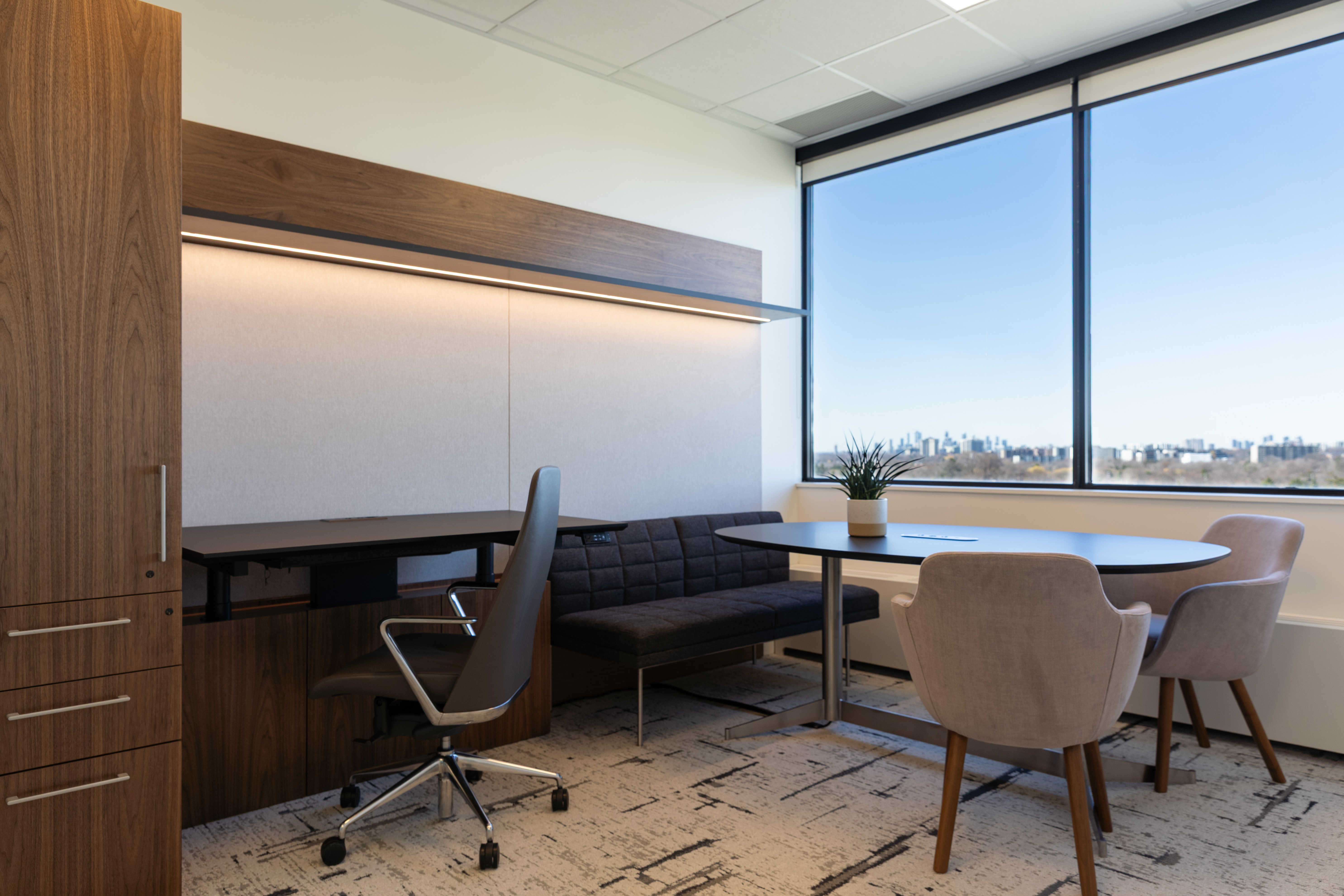
What the upgrade actually costs
Across Toronto and the inner GTA, solo private offices in flex spaces generally run between $900 and $1,800 per month, depending on location, finish, and whether windows are involved. A dedicated desk in the same buildings typically sits between $450 and $750 per month. A hot desk runs $250 to $450.
So the gap between "I have my own desk in a shared room" and "I have my own room" is usually $400 to $1,000 per month, or roughly $4,800 to $12,000 per year.
That's not a small number on a solo P&L. I run a coworking space and I also come from commercial real estate (my family's company, Jilani Group, has been in Etobicoke for decades). I think about fixed cost on small operators a lot, and one of the things I tell solo entrepreneurs honestly is this: the cost of an unnecessary upgrade isn't just the dollars. It's the fixed obligation on revenue that hasn't proven out yet.
If you're three years into a stable practice with predictable revenue, $10K of additional fixed cost is a planning question. If you're eighteen months in and the pipeline is lumpy, it's a risk question. Different math.
Now, to the four situations where the math works.
1. You're on video calls more than two hours a day
This is the single most common reason solo entrepreneurs upgrade and the one I'd defend hardest. Coworking spaces have meeting rooms and phone booths, but if you're running back-to-back calls (sales calls, client check-ins, coaching sessions, therapy appointments), the friction of booking rooms, walking between them, and managing background noise becomes its own job.
A private office removes that entirely. You walk in, close the door, and your calls happen wherever you happen to be sitting. No reservation system, no awkward wait when your 3pm runs over and the room is booked at 4.
If your calendar regularly shows ten or more hours of calls per week, run the math. The hours you save in logistics often justify the spend on their own.
2. You meet clients in your space
If your work involves clients coming to you (lawyers, accountants, financial advisors, consultants who run strategy sessions in person), the room itself is part of the signal. A private office tells the client you have a place of business. A dedicated desk in an open room doesn't, no matter how nice the building is.
This is also where founders sometimes overestimate the need. If you meet clients twice a month, a meeting room booking handles it cleanly and they'll never know it wasn't your full-time office. If you meet clients twice a week or more, the booking friction starts to add up and a private office becomes the cleaner answer.
3. You handle confidential or regulated work
Legal, financial, healthcare, anything under privacy legislation or covered by NDAs. If you can't have your screen visible to anyone walking past, can't take calls in shared space, and need to store physical files securely, a private office isn't a luxury. It's a compliance requirement.
I won't dwell on this one because if it applies to you, you already know.
4. You need to leave equipment or materials set up
Multi-monitor setups, lighting rigs for content work, product samples, design tools, anything you'd rather not pack up at the end of every day. A dedicated desk gives you a fixed spot, but it's still in a shared room, which means surface area is limited and security on personal equipment is informal.
If your work has physical infrastructure that lives at your workspace, a private office solves a daily logistics problem.
Where a private office is overkill
Outside those four, here's where I see solo entrepreneurs spend money they didn't need to:
Heads-down knowledge work with occasional calls. Writers, developers, designers, analysts. A dedicated desk plus a phone booth for the occasional call covers this completely. You're paying for silence you already have in a well-designed coworking space.
Anyone whose business benefits from serendipity. Business development, partnerships, anything sales-adjacent. Sitting in a private room defeats one of the actual reasons coworking has value, which is the unplanned conversations with people in other industries. I see this constantly: the founder who upgrades to an office and then complains they don't meet anyone in the building anymore.
Anyone in their first eighteen to twenty-four months. This one is mostly about fixed cost. Until your revenue is predictable, a $1,000+ monthly commitment that scales nothing is the kind of cost that looks fine in a good month and painful in a slow one. Stay flexible until the business tells you it's ready for the upgrade.
The middle option most people skip past
Dedicated desk plus deliberate use of meeting rooms.
This combination handles a surprisingly large share of the use cases people assume require a private office. You get a permanent spot for daily work, predictable monthly cost, access to phone booths for calls, and bookable rooms when clients come in or you have a confidential meeting.
The reason it gets overlooked is that "I want my own office" is an emotionally satisfying upgrade, and "I'll book a room when I need one" feels like a workaround. But functionally, for most solo work patterns, the workaround is the right answer for at least another year.
The buildings I'd actually recommend are the ones where the meeting rooms are good enough that you don't feel like you're slumming when you book one. If the rooms are an afterthought, the strategy doesn't work.
How to test before you commit
If you're seriously considering a private office, do this first: take a dedicated desk for a month and use it intentionally. Book a meeting room every time you'd want privacy. Track how often you wished you had your own door.
By the end of the month, you'll know. Either you'll have used the meeting rooms three times and felt fine, in which case the dedicated desk stays. Or you'll have hit booking conflicts, called clients from your car, or felt the lack of a fixed space for your equipment, in which case the upgrade is justified and you'll know exactly why it's justified.
This is also how I'd approach it if I were on the buying side. The price difference between a dedicated desk and a private office over a single month is small. The price difference over a year you didn't need is significant.
The honest answer
A private office is worth it for a solo entrepreneur if you spend most of your day on calls, meet clients in your space regularly, work in a regulated field, or have equipment that has to stay set up. If two or more of those apply, don't even bother with a dedicated desk. Go straight to the office.
If none of them apply, a dedicated desk with good meeting room access is the better buy, and probably will be for at least another year. Save the difference, or put it back into the business in something that actually scales revenue.
If you want to test the question without committing, our day pass at Jilani Place gets you in for a full working day so you can see the space, try the meeting rooms, and get a sense of whether the dedicated-desk-plus-rooms strategy would work for how you actually operate. From there, the decision tends to make itself.
Fahad Jilani is the Founder of Jilani Place.