
Private Offices
Private Office vs. Dedicated Desk: Which Do You Need?

Fahad Jilani
Founder, Jilani Place
Last updated
Most people frame this decision as a privacy question. It isn't. The right question is how often you need to control your environment, and once you answer that honestly, the choice between a dedicated desk at $850 a month and a private office at $2,500 usually makes itself.
I created a coworking space in Etobicoke and I have this conversation with prospective members two or three times a week. Almost everyone walks in assuming they want a private office. Most of them, after we talk through how they actually work, realize a dedicated desk plus booked meeting rooms covers what they need at a third of the cost. A smaller group realizes the opposite: they've been losing real money trying to make a desk work for a job that needs a door.
This article is the framework I use with them.
What a dedicated desk actually gets you
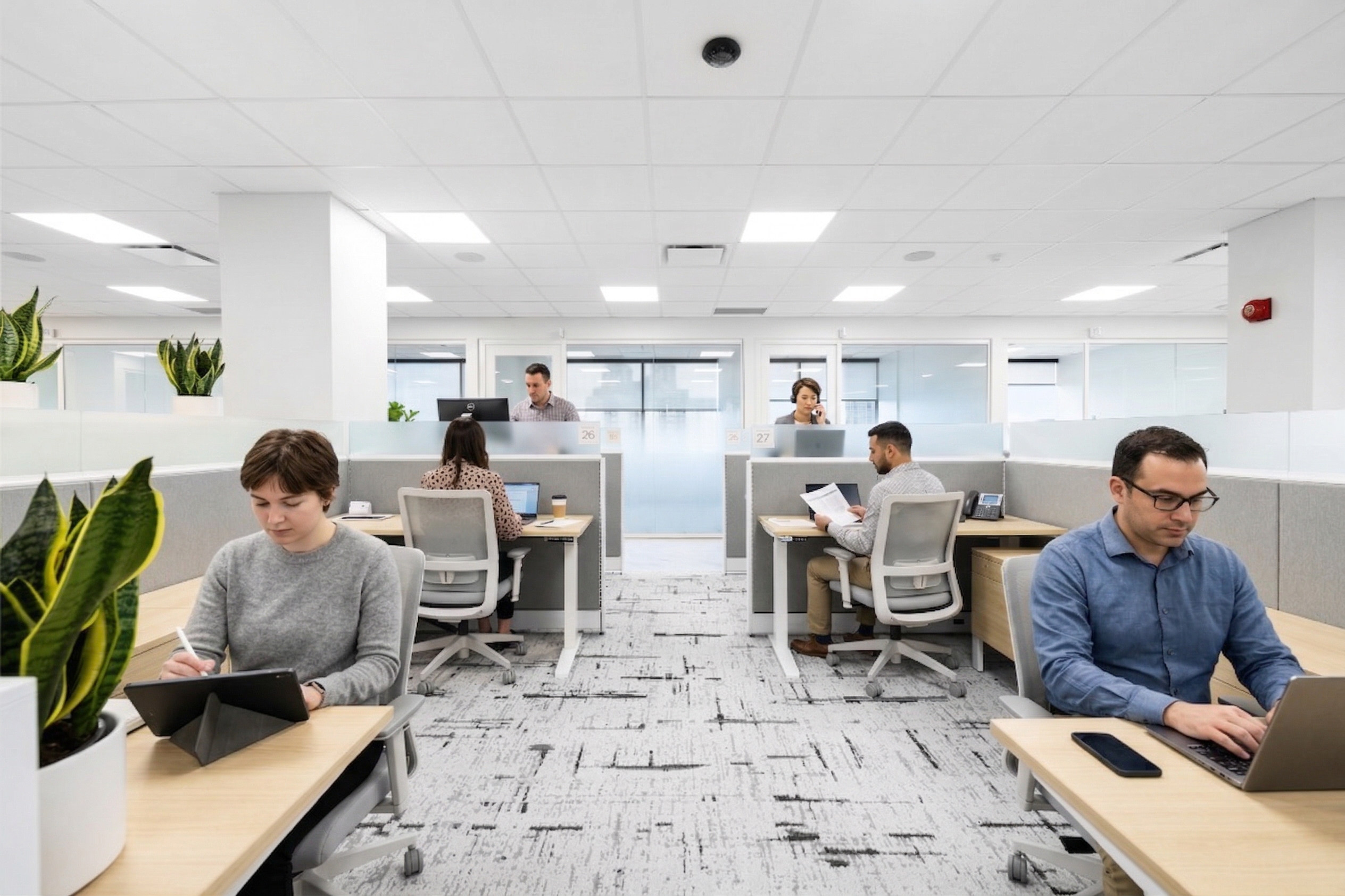
A dedicated desk is your spot. You leave your monitor, your books, your second keyboard, and they're there when you come back. You get a lockable cabinet or drawer, a mailing address, after-hours access, and usually some included meeting room hours each month. At Jilani Place that runs $850 a month and includes everything I just listed.
What you don't get is a door. You're working in a shared acoustic environment, which is fine for focused individual work, email, and most video calls if you keep them brief or use a phone booth. You can't leave anything especially valuable out overnight unless you trust the security setup, which at most premium spaces is fine, but it changes how you work. You also share air, sightlines, and conversation overflow with whoever else is on the floor that day.
For most independent consultants, marketers, designers, writers, and analysts in the first few years of their solo practice, this is enough. The constraint is real but it isn't crippling, and the price reflects that.
What a private office actually gets you
A private office is a room with your name on the door. You control the lighting, the temperature within reason, and most importantly the acoustics. You can be on a call for three hours without rotating through phone booths. You can leave a desktop tower, multiple monitors, paper files, and a guest chair set up exactly how you want them. You can have a client walk in, sit down, and not feel like they're at a hot-desk visitor pass.
At Jilani Place a private office starts at $2,500 a month. That's a real jump from $850, and I'm not going to pretend it isn't.
What you still don't get, even at that price: dedicated parking that's yours alone, a private kitchen, a private bathroom, or a private lobby. You're still using the building's shared amenities. The cheapest private offices in any premium space are also smaller than people expect, often 100 to 150 square feet, which fits one person and a guest comfortably and not much else.
If your work doesn't require any of the things in the first paragraph, you're paying $1,650 a month extra for a door you didn't need.
The honest Toronto comparison isn't desk vs. office
The real comparison once $2,500 is on the table isn't dedicated desk versus private office. It's coworking private office versus a small leased office of your own, because that's the alternative people are usually weighing.
I came up in commercial real estate (my family runs Jilani Group), and the numbers on small leased offices in the GTA are worse than most people realize. A 150 to 200 square foot office in Etobicoke or midtown Toronto, by the time you add base rent, additional rent (TMI), utilities, business internet, furniture, cleaning, and insurance, lands somewhere between $2,800 and $4,200 a month all-in. That's before the lease commitment, which is typically three to five years and personally guaranteed.
So $2,500 a month for a furnished private office with no lease, no utility setup, no internet contract, and the option to walk away with 30 days notice is competitive with the leased alternative once you account for everything. It isn't cheap. It's priced fairly against the real comparison.
The dedicated desk at $850 isn't competing in that market at all. It's competing with your kitchen table, a Starbucks, and a public library. The question with a dedicated desk is whether $850 a month buys back enough productivity, professionalism, and sanity versus working from home. For most people the answer is obviously yes, which is why dedicated desks are the most common membership tier in coworking globally.
The three variables that actually decide it
Privacy is not the deciding variable. Three other things are.
1. Call volume
Track your actual call hours for one week. If you're on video or phone calls more than two hours a day on average, a dedicated desk gets uncomfortable, both for you and for whoever is sitting near you. Phone booths help, but rotating in and out of them four or five times a day is its own form of friction. At three hours a day or more of calls, a private office isn't a luxury. It's the only setup that works.
2. Client meetings on your turf
If clients come to you weekly or more often, a private office changes how the meeting feels. Booking a meeting room from a dedicated desk is fine for occasional visits. It starts to feel performative if you're doing it every Tuesday. There's also the small but real signal of having an office with your name on the door versus borrowing a room. Some clients don't care. Some do. You know which kind you have.
3. Equipment and confidentiality
This one is binary. If you need three monitors, a desktop tower, a printer, paper files, or a whiteboard you don't want erased, you need a private office. If you work in a regulated industry (law, accounting, financial advice, healthcare, anything with confidentiality requirements), you need a private office. The coworking floor isn't appropriate for files that can't be left out, screens that can't be seen, or conversations that can't be overheard. There's no workaround here.
If you score zero out of three on these, a dedicated desk is the right answer and you'd be wasting money on a private office. If you score one out of three, it depends on intensity, and the middle path I'll describe in a minute is probably right. If you score two or three out of three, you're already paying for a private office in lost productivity, awkwardness, or compliance risk. You just haven't moved the cost to the line item where it belongs.
When a dedicated desk is genuinely enough
The independent consultant doing mostly async work, taking maybe one call a day, meeting clients at their offices or over Zoom, working off a laptop with no special equipment, with no regulated-industry confidentiality requirements: that person doesn't need a private office. They need a quiet place that isn't their kitchen, a community of other professionals to absorb some of the loneliness of solo work, and the ability to leave their stuff overnight.
That's what $850 buys at most premium coworking spaces in the GTA, and it's a reasonable price for what you get. Most of the independent professionals at Jilani Place in their first few years of solo practice are on dedicated desks and have no plans to move up. They use meeting rooms when they need to (most plans include a few hours a month, with additional hours bookable), they take calls in phone booths when needed, and they get their work done.
If that's you, stay there. The upgrade isn't free and the gap isn't trivial.
When the upgrade pays for itself
The math on the upgrade is simpler than people think.
The gap between $850 and $2,500 is $1,650 a month, or roughly $19,800 a year. For that to make sense purely on productivity, the private office needs to give you back somewhere around 25 to 35 hours a month of work you're currently losing, depending on your billable rate. That's a little more than an hour a day.
If you're rotating through phone booths, getting interrupted on the floor, rescheduling calls because you can't find a private space, or context-switching every time someone sits down next to you, you can lose an hour a day without noticing. I've watched members track this for a week and surprise themselves.
The other case where the upgrade pays for itself is client perception. If you're closing five-figure or six-figure deals and the meeting environment matters to your win rate, the office is part of your sales infrastructure, not your overhead. One additional close a year usually pays for the entire upgrade.
If neither of those applies to you, the upgrade probably doesn't pay for itself, and you should stay on a dedicated desk.
The middle path most people miss
Most people pick between dedicated desk and private office without considering the third option, which is dedicated desk plus heavier use of meeting rooms.
Most premium coworking memberships include a few meeting room hours per month and let you book additional hours at a published rate. If you need a private space for two hours a day, three days a week, that's around 24 hours a month of bookings. Depending on the space, that might cost an extra $200 to $400 a month. Add it to your $850 dedicated desk and you're at $1,050 to $1,250 a month, still meaningfully below $2,500, and you've covered the use cases that drive most upgrades.
This works if your private-space needs are predictable and concentrated (a daily morning call block, weekly client meetings on Tuesdays). It doesn't work if your needs are scattered and unpredictable, because you'll spend half your time hunting for an open room.
For the right work pattern, this is the cheapest right answer.
How to actually decide
If you're still on the fence, the cheapest decision is to come in on a day pass and try the floor before committing to either tier. Sit at a desk for a day, take your usual calls, do your usual work, and pay attention to what bothers you. Whatever bothers you is your answer. If the noise and lack of privacy bother you within a few hours, you need an office. If they don't, you don't, and you've just saved yourself $19,800 a year.
Fahad Jilani is the Founder of Jilani Place.