
Private Offices
What's the Smallest Private Office I Can Rent in Toronto?

Tamar Gagnidze
Community Manager
Last updated
The smallest private office you'll find in Toronto sits somewhere between 60 and 100 square feet, and it's almost always inside a coworking space. Traditional commercial leases rarely dip below 400 square feet, so if you want your own door without renting a small storefront's worth of space, coworking is realistically the only option. Most rooms at this size fit one person, one desk, a chair, and not much else.
I'm the community manager at Jilani Place, and "what's the smallest you have?" is probably the most common question I get from solo professionals on a tour. The honest answer is more interesting than the literal one, so let me walk you through what small actually looks like in Toronto, what one person realistically needs, and where most people land after they've sat in the room.
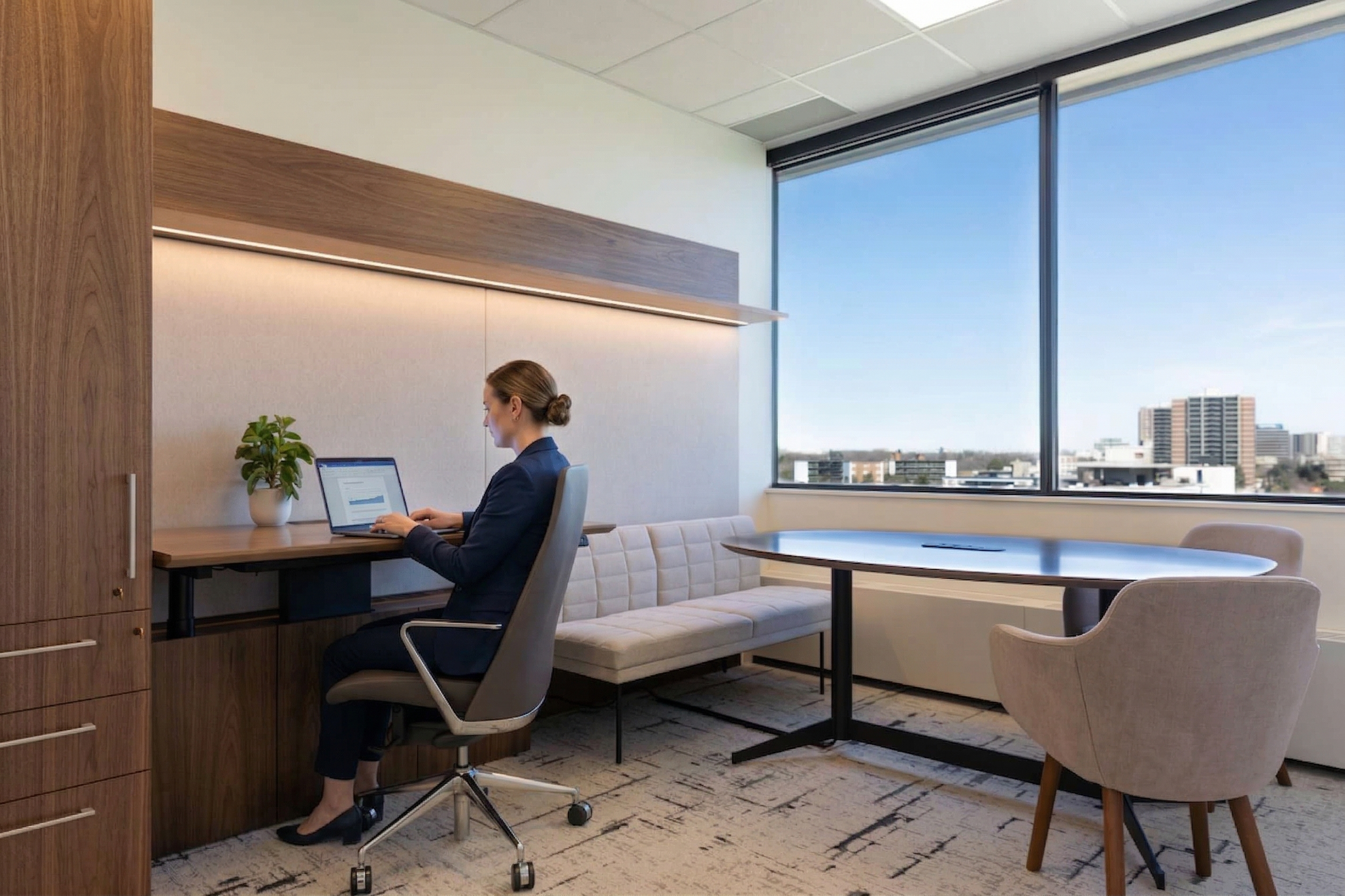
What "small" really means for an office
There's a workspace design rule of thumb that budgets 150 to 175 square feet per person to fit a desk, a chair, and enough room to move around. That's the number commercial real estate planners use when they design floors for traditional companies.
Coworking private offices play by different rules. The square footage quoted for a coworking private office usually doesn't include the shared kitchen, the meeting rooms, the lounge, or the bathrooms, so the room itself can be much smaller without the day-to-day experience feeling cramped. You're not eating lunch at your desk or running a six-person meeting in your office; you're using the rest of the space for that. The office is just the part with the door.
That's why solo entrepreneurs in Toronto frequently choose studios under 100 square feet, while teams typically need 200 to 500. When I show someone a 75 sq ft office for the first time, they almost always say the same thing: "Oh, it's smaller than I pictured." A few minutes later, after they've sat down at the desk and looked around: "Actually, this is fine."
Where you can actually find offices this small in Toronto
If you're looking for under 200 square feet, your options are basically:
Coworking spaces with private offices
This is where the supply is. Most operators across Toronto offer at least a few one-person rooms in the 60 to 120 sq ft range, with bigger options up the ladder.
Executive suite operators
Companies like Regus and Premier Workspaces have single-person offices in this size category in some buildings, often packaged with reception and mail handling.
Traditional commercial leases
Effectively not an option at this size. Direct leases in Toronto generally start at several hundred square feet, and even small subleases tend to come with multi-year commitments and fit-out costs that don't make sense for one person.
For context on how out of reach traditional leasing is for solo professionals: downtown Toronto office space averaged about CA$37.20 per square foot in fall 2024, with planners typically allocating 150 to 250 square feet per person. That math gets unfriendly fast when you're a sample size of one.
What one person actually needs in an office
Here's where my front-desk observations matter more than industry averages. The people who book the very smallest room often come back within a few months and ask about something a touch bigger. It's almost always the same reason.
A desk, a chair, and a monitor fit in 60 sq ft. A second chair doesn't, comfortably. And the second chair is the part everyone underestimates on the tour.
If you're a consultant, a financial advisor, a therapist, a lawyer, a coach, a recruiter, or anyone who occasionally has a person sit across from you, that second chair is the difference between a private office and a phone booth with a view. You don't need a conference table in your office (you can book a meeting room when you need one), but you probably do want the option of having someone drop in for fifteen minutes without it feeling claustrophobic.
The other thing people forget: storage. Even a paperless practice ends up with a printer, a few books, a set of headphones, a coat, a bag, and somewhere to put a glass of water without knocking over the laptop. A 60 sq ft office can absorb that, but it doesn't leave much margin.
What it costs in Toronto
Pricing for small private offices in Toronto coworking spaces ranges roughly from the high $500s to over $1,200 a month for a single occupant, depending on location, building class, and what's bundled in. A few reference points from the public market:
- Workplace One advertises private offices starting around $495 a month, with dedicated desks at $350.
- Industrious Yonge & Bloor lists in-person workspaces starting at CA$540 a month, while their Financial District location starts around $450.
- Across the broader Toronto market, private office pricing in coworking has historically ranged up to roughly $800 a month for solo occupants, though in central neighbourhoods the high end is meaningfully above that today.
What you're paying for at this price point isn't really the room. It's the room plus the building (reception, cleaning, utilities, mail), plus access to meeting rooms when you need to host more than one person, plus a community manager who notices when your printer is jammed. Compare that to a traditional lease, where rent is just the start and you're separately on the hook for utilities, internet, furniture, insurance, and a few thousand dollars of fit-out.
The honest tradeoffs of going as small as possible
I want to flag the parts of small-office life people don't realize until they're living it:
Video calls feel different
When the camera is two feet from your face and the wall is a foot behind you, it shows. Some people don't mind. Some people want to throw a plant in the frame and can't.
You can't host without it feeling tight
Even a fifteen-minute client check-in in a 60 sq ft room means knees almost touching. For some practices that's intimate in a good way. For others it crosses a line.
Whiteboards, monitors, supplies
If you work visually, you'll feel the wall space limit before anything else.
Resale and upgrade friction
This one's specific to coworking, but worth knowing: when you outgrow your room, you have to wait for a bigger one to open up. If your space is fully booked at the size you want, you may sit on a waitlist.
For a portion of solo professionals, none of this matters. They want a quiet door, a strong internet connection, and a place to land a few days a week. The smallest room is exactly what they need. For others, going one size up makes the difference between dreading the office and actually wanting to come in.
How to figure out what size fits you
The cheapest way to find out is to spend a day in the building first. A day pass lets you work from the common area, take a few calls, eat lunch, and notice how the space feels at different times of day. Most coworking operators will happily walk you through their available private offices the same day you visit.
If you can, sit in the smallest room they have, then sit in one a size up. Take a few minutes in each. The right answer often becomes obvious within ten minutes. I've watched people walk in convinced they wanted the cheapest room and walk out signing a lease on the next size up because they pictured an actual workday in it.
A dedicated desk in the open space can also be a useful stepping stone. You get most of the benefits of a coworking membership without committing to a private room until you know what size you actually need.
Worth a visit
If you're working through this decision and you're somewhere in the west end of the GTA, come spend a day at Jilani Place on a day pass. You can see the smallest private offices we have, sit in a few, and use the rest of the building like a member for the day. No pressure to decide anything. The smallest room you can rent is a useful number to know, but the size that actually fits the way you work is the only one that matters in practice.
Tamar Gagnidze is the Community Manager at Jilani Place, a premium coworking space at 295 The West Mall in Etobicoke, where she leads member experience and day-to-day operations for solo professionals and small teams across the GTA.