
Meeting Rooms
Why We Set Up a Podcast Room at Jilani Place

Fahad Jilani
Founder, Jilani Place
Last updated
We built a podcast room because members kept asking where to record, and the existing Toronto options forced them to choose between $150-an-hour engineered studios downtown and DIY home setups that sounded like they were recorded in a parking garage. Neither worked for the solo consultants, founders, and advisors who use Jilani Place. Here's what we built, who we built it with, and why it lands at $99 an hour with a one-touch workflow instead of a producer in the room.
The demand signal
At some point in the last two years, "where can I record a podcast?" became one of the more common questions Tamar gets at the front desk. Almost every member asking that question fits the same profile: an independent professional treating a podcast as a marketing channel. Realtors building a buyer-education show. Financial advisors interviewing clients. Agency founders running thought-leadership episodes. Coaches recording video clips to repurpose on LinkedIn.
This isn't surprising. Edison Research's Infinite Dial Canada has tracked steady growth in Canadian podcast listenership for years, and the creator side has followed. What's changed recently is who's recording. Five years ago, a podcast meant a hobbyist with a USB mic. Today it means a solo professional building distribution.
The members asking us about recording weren't shopping for a studio. They were trying to figure out the cheapest, fastest way to publish a decent-sounding episode without making a project out of it.
Why the existing options didn't fit
The Toronto landscape isn't bad. There are real podcast studios doing good work: Pop Up Podcasting, Indoor Recess, Toronto Podcast Studio, a handful of others. Going rate is roughly $100 to $150 per hour with an engineer included, and the product is genuinely good.
But for a solo professional recording a 30-minute episode between two client meetings, that price point is hard to justify, the booking is downtown, and the production overhead (briefing the engineer, scheduling around their availability) ends up bigger than the recording itself.
The DIY route has its own problems. A reasonable home setup runs $500 to $3,000 once you factor in mic, interface, treatment, and a quiet enough room. Most home offices sound terrible on a microphone. Echo, HVAC roar, the dog, the neighbour's leaf blower. People send me audio they recorded in their bedroom and ask why it sounds amateur. It sounds amateur because their bedroom is amateur for audio.
The middle option (coffee shops, hotel rooms, Airbnbs) is a coin flip on whether the room is usable, and the answer is usually no.
There was a gap, especially in Etobicoke and the west end. Members were either driving downtown to spend $150 an hour or duct-taping something at home and being unhappy with the result.
The brief we wrote ourselves
Once it was clear the gap was real, the brief for the room more or less wrote itself. Three constraints, all of them lifted from member conversations about what stopped them from publishing more often.
It had to be in the building. A member shouldn't have to plan their day around recording. The whole point is to walk out of a client meeting, record an episode, and be back at their desk in under an hour. Anything that required a separate trip across the city would defeat the purpose.
It had to be priced so members could use it weekly. $150 an hour with an engineer is fine for a quarterly project. It's not a tool you reach for to publish a weekly show. We landed at $99 an hour, bookable on the hour, no engineer fee, no minimum block. Cheap enough that the recurring cost stops being the reason people procrastinate.
It had to work without an engineer. A non-technical solo professional should be able to walk in, hit record, walk out with usable audio. No software to learn, no setup, no production person to schedule. This was the hardest constraint, and it's the one OCTAV solved.
Fifteen years in commercial real estate before starting Jilani Place taught me something useful here: the best opportunities are usually unmet needs in a specific submarket, not better versions of a saturated category. There were already excellent podcast studios in Toronto. There wasn't one built around how a busy independent professional actually wants to record.
The OCTAV partnership
The room only works if it's stupid-simple to use. This is the part most coworking operators get wrong when they try to add a podcast room: they buy good equipment, leave it in the room, and assume members will figure it out. Members won't figure it out. They don't want to learn Logic or Adobe Audition before recording their first episode, and they shouldn't have to.
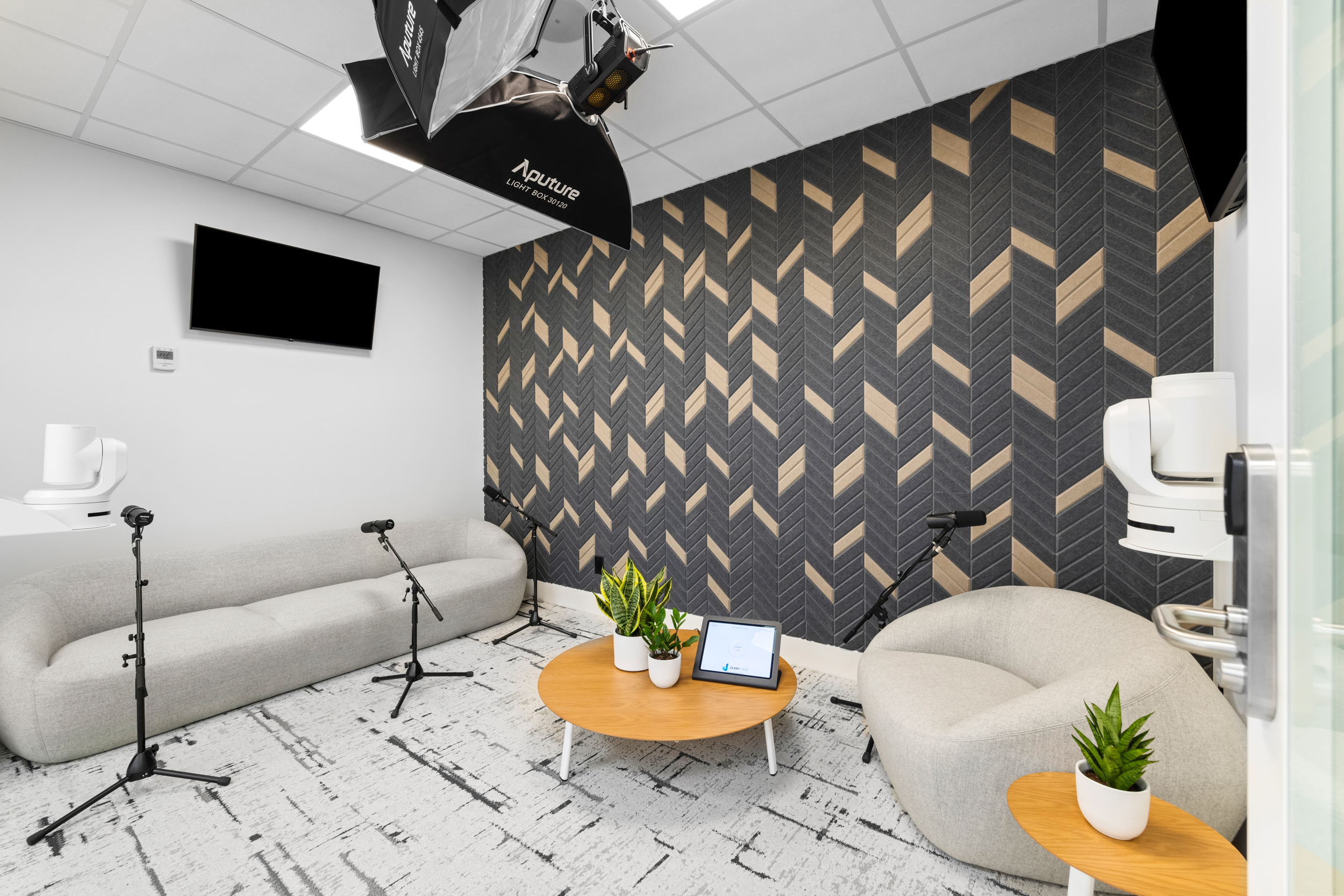
We worked with OCTAV, a Toronto-based audiovisual consultancy, to design the signal chain end-to-end. Mics, cameras, mixer, lights, recording capture, all preconfigured and routed through a single control iPad mounted on the desk. The member walks in, taps their format on the iPad (solo, two-person interview, remote guest), hits record, and leaves with files delivered to their inbox.
What that workflow removes:
- No microphone gain-staging
- No software to launch or learn
- No engineer to book or brief
- No exporting, converting, or wrangling file formats
- No guessing whether the recording is actually capturing
That last one is the biggest. Anyone who's recorded a podcast has had the moment where they realize the mic wasn't on, or the wrong source was being captured, or the levels were so hot the audio is unusable. The OCTAV setup eliminates that anxiety because the system is preconfigured for the formats members actually use. There's no chain of decisions where something can be misconfigured.
OCTAV's brief was simple: build a room a non-technical solo professional can walk into and use confidently, the first time, alone. They delivered.
What's actually in the room
Briefly, because spec lists are boring:
- Acoustic treatment on the walls and ceiling, sized for spoken-word recording
- Broadcast-quality condenser and dynamic mics depending on use case
- Multi-camera setup for video podcasts and clip repurposing
- Studio lighting preconfigured for the seated positions
- Control iPad with preset formats
- Wifi running on Ubiquiti enterprise hardware (relevant because remote-guest recording over Riverside or Zencastr depends entirely on local upload reliability, and consumer routers don't cut it)
- Capacity for solo, two-person, or three-person setups
Files are delivered as separated tracks, so editing later is straightforward. If you don't edit, the mixed file works as-is.
Who the room is for, and who it isn't
Worth being honest about fit, because nothing kills credibility faster than pretending a room does everything.
The room is built for: solo professionals recording marketing podcasts, two-person interview shows, remote-guest interviews via Riverside or Zencastr, video clips for LinkedIn and YouTube, occasional in-person guests, and founders or consultants who want a presentable backdrop for client-facing video content.
The room isn't built for: full production teams with their own engineers, music recording, live-mixed podcasts that need an engineer riding faders in real time, four-plus person panel discussions, or anyone whose workflow demands a Phase One or Vespa-grade studio. If that's you, book one of those rooms. They're worth the money for the use case.
For everyone else (which is most independent professionals starting or running a podcast), the room covers the 90% case at $99 an hour with no engineer to coordinate.
Try it before you commit
If you're thinking about starting a podcast, or already recording one and tired of the home-office workaround, the easiest way to evaluate the room is to come record something. A day pass gets you into the building, lets you test the iPad workflow, and gives you a usable file at the end of it.
That's how the room was built to be used: walk in, hit record, walk out with audio you can publish. The rest follows from there.
Fahad Jilani is the Founder of Jilani Place.