
Coworking
How to Be Productive in a Coworking Space

Tamar Gagnidze
Community Manager
Last updated
The remote employees who get more done at Jilani Place than they did at home all tend to do the same six things in their first month, and almost everyone else gets the same six things wrong without realizing. Productivity in a coworking space isn't an automatic upgrade from working at your kitchen table. It's a small set of decisions about where you sit, how you handle calls, how you take breaks, and how light or heavy you go on the social side. Here's what I see from the front desk.
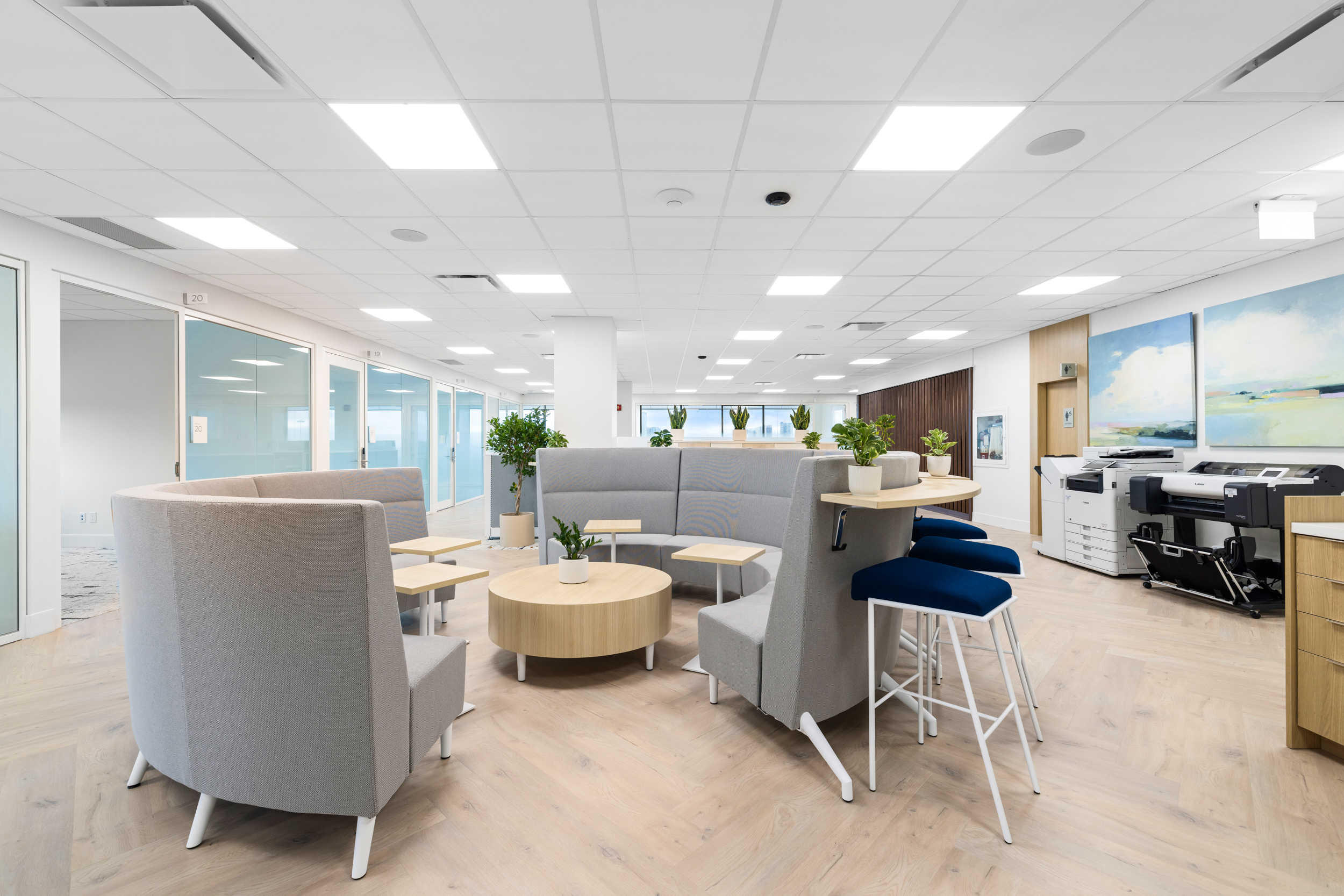
1. Pick your seat like it matters
The single biggest predictor of a productive day is where you choose to sit, and most new members don't realize they're making a choice at all.
Some sit at the same desk every visit for the first month, decide they don't like it, and tell me they're "trying coworking out" before they've actually tried different parts of it. Others rotate strategically. A window seat for deep writing in the morning when natural light helps, a quieter corner in the afternoon when energy dips, somewhere closer to the kitchen at the end of the day when admin replaces calls.
If you're sensitive to background talking (and research suggests almost everyone is, even people who don't notice consciously), pick the quietest part of the space for your hardest work. A 2011 study in the Journal of Environmental Psychology by Jahncke and colleagues found that working memory drops measurably under open-plan office noise compared to quiet conditions, with participants remembering fewer words after working in higher-noise environments. You don't need a sealed room. You do need to know that the distance between a desk near the kitchen and a desk in a quiet corner is, for cognitive work, much bigger than it looks on a floor plan.
2. Use the phone booths, even when you don't think you need to
The mistake almost every new member makes in their first month is taking a "quick" call at their desk.
The call itself isn't the problem. The problem is that you've now broadcast your conversation into a shared workspace, broken your own focus by speaking instead of writing, and given everyone within earshot a small reason to resent you. Then on your next call, the person two desks over is doing the same thing back, and you're both worse off.
Background speech is consistently identified in workplace acoustics research as one of the most disruptive types of noise for cognitive tasks; it interferes with working memory in a way that music or traffic noise does not. The fix is mechanical, not motivational. Book the phone booth. Even for a six-minute check-in. The members who treat phone booths as the default for any call, not the exception for "important" calls, are the ones who tell me six months in that they get more done here than they ever did at home.
3. Treat your commute as the start of work, not a chore
This one I learned from members, not from research.
If you've been working from home for a few years, you've lost something most office workers used to take for granted: the psychological transition into work mode. The 15 minutes between your front door and your desk used to be where your brain shifted gears. Without it, you're trying to do focused work from the same chair where you ate cereal an hour ago.
Members tell me the commute to Jilani Place, even a short one, is one of the underrated benefits of having a third place. They listen to a podcast on the way in, plan the day's three priorities while driving down The West Mall, and arrive already half warmed up. The drive home at the end of the day flips it: it becomes the off-switch that "logging off" never quite was when home and office were the same room.
If you're shopping for a coworking space and you happen to live close to one, resist the temptation to pick it purely for the convenience. A 15-minute commute, in either direction, is doing more work for your focus than you think.
4. Build one or two light social anchors, not zero and not ten
This is where I see the biggest split between members who renew and members who don't.
Some new members put their head down on day one and don't speak to anyone for three months. They tell me they came here to focus, not to network, and they're not wrong, exactly. But they also tell me, around month four, that they're thinking of cancelling because the space feels "kind of lonely." Of course it does. They've spent 60 days being a stranger in a room full of strangers.
The other extreme: members who treat the space as one long networking event, hover near the front desk, and leave at 5pm having had a great time and produced almost nothing.
The middle is what works. One coffee chat a week. Lunch with someone occasionally. Knowing maybe four people's names and what they actually do for a living. That's enough to make the space feel like yours without bleeding into your work hours, and it's the layer that most people working from home are quietly missing without being able to name it.
5. Use Cafe 295 as part of your workday, not a distraction
Jilani Place has Cafe 295 on the ground floor. It's a working coffee shop, not a member lounge, and that distinction matters more than it sounds.
A lounge invites you to linger past the point of usefulness. A cafe gives you a cleaner structure: order something, drink it, go back. The members who use Cafe 295 well treat it as a deliberate break tool. A mid-morning espresso to reset before a hard task. A casual client meeting that doesn't need a booked room. Twenty minutes with a book at 3pm when energy is dipping and a screen break will do more for the next two hours of work than pushing through.
Rachel and Stephen Kaplan's research on Attention Restoration Theory, which has been replicated many times since the original work in the 1980s, suggests that brief breaks in qualitatively different environments restore directed attention more effectively than just stopping work in the same chair. Going downstairs for a coffee qualifies. Switching browser tabs does not.
The people who never use the cafe are usually the same people who tell me, a little sheepishly, that they hit a wall every day around 2pm and can't figure out why.
6. Don't try to replicate your home office at a new address
The members who arrive on day one with three monitors, a split keyboard, a vertical mouse, and a webcam ring light are usually the same members who go back to working from home within a month.
It's not the equipment that's wrong. It's the project. You came here for the things home doesn't have: separation, light human contact, a reason to put on real clothes, an environment your brain associates with work and only work. If you spend the first hour of every visit setting up a dock, you've already lost the lightness that makes coworking different from working at your kitchen table.
Travel light instead. A laptop riser and a good external keyboard fit in a tote bag. Most knowledge work doesn't actually require three screens, despite what your home setup has trained you to believe. The members who pack light tend to come in more often, and frequency is the only thing that actually compounds.
The thing nobody tells you in week one
Productivity in a coworking space comes down to respecting one thing: you're sharing the room with other people who are also trying to work. The members who internalize that in their first two weeks get more done than they did at home, almost without exception. The members who treat the space as an extension of their living room never quite figure out why it's not working.
If you've been working from home and you're wondering whether a coworking space would actually move the needle on your output, the cheapest way to find out is a day pass. One day won't tell you much. A day pass now, and another one two weeks later, after you've had time to think about what worked and what didn't, will tell you almost everything. You can grab a day pass at Jilani Place whenever you're ready, and I'll usually be at the front desk if you have questions.
Tamar Gagnidze is the Community Manager at Jilani Place, a premium coworking space at 295 The West Mall in Etobicoke, where she leads member experience and day-to-day operations for solo professionals and small teams across the GTA.