
Remote Employees
Why I Built Jilani Place Around a Coffee Shop

Fahad Jilani
Founder, Jilani Place
Last updated
Most coworking operators put a Nespresso machine in the kitchenette and call it amenities. I did the opposite. I built Cafe 295 first, then designed the coworking around it, because the thing remote employees actually miss when they leave home isn't an office. It's a coffee shop that takes them seriously.
That decision wasn't a branding move or a hospitality flourish. It was a design thesis, and it came out of three years of watching the same thing happen across the GTA.
The pattern I kept seeing
The office didn't come back. Not really, not for the people whose work fits in a laptop. Companies announced return-to-office mandates, then quietly stopped enforcing them. Employees who could work from anywhere stopped working from the office, and most of them didn't want to work from home either, at least not five days a week.
So they went to coffee shops. And they kept going. They kept going after their backs started hurting from wooden chairs, after their laptops died at 2 p.m. with no outlets in sight, after the espresso grinder drowned out their third call of the day. They kept going even when it stopped being efficient, which told me something. Whatever the coffee shop was giving them, it was worth the friction.
What a coffee shop actually gives you
A real cafe gives you something the corporate office and the home office both fail to deliver: the feeling of being out in the world without having to perform. The activity around you is low enough that you can think, and high enough that you don't feel like the last person on earth. You have a reason to leave the house in the morning. You get a natural transition between focus and break, because ordering another drink forces you to stand up and look around.
Sociologist Ray Oldenburg had a name for this. He called it a "third place," a setting that isn't home and isn't work, where you maintain a casual, low-stakes relationship with the people around you. He was writing about pubs, barbershops, and corner stores in 1989. Almost forty years later, the third place that survived for knowledge workers is the cafe. That's not an accident. It's the only third place left that tolerates a laptop on the table for five hours.
What a coffee shop fails to deliver
It's also, on every other dimension, a bad place to build a career.
The chairs are designed for forty-minute visits, not forty-hour weeks. The WiFi handles a Slack message and starts dropping packets the moment you join a Zoom. There's no privacy, so half the calls you take, you take in the parking lot or whispering into your sleeve. There's nowhere to host a client meeting that doesn't put you in the middle of the lunch rush. And there's the slow, polite social pressure of a barista who needs you to either order something or give the table to someone who will.
Coffee shops are wonderful. They are also, when the day stretches past two hours, actively working against you.
The design thesis
The standard coworking response to all of this is to import a few coffee shop signals into the office. Exposed brick on one wall, a specialty espresso machine in the kitchen, a barista on Tuesdays. It looks the part. It doesn't feel the part, because the texture of a real cafe doesn't come from the espresso machine. It comes from the fact that the cafe isn't an office. Strangers walk in. Regulars walk in. The door swings open every few minutes, somebody is laughing in the corner, somebody else is on a first date at 3 p.m. on a Wednesday. You can't manufacture that with a Nespresso pod and some Edison bulbs.
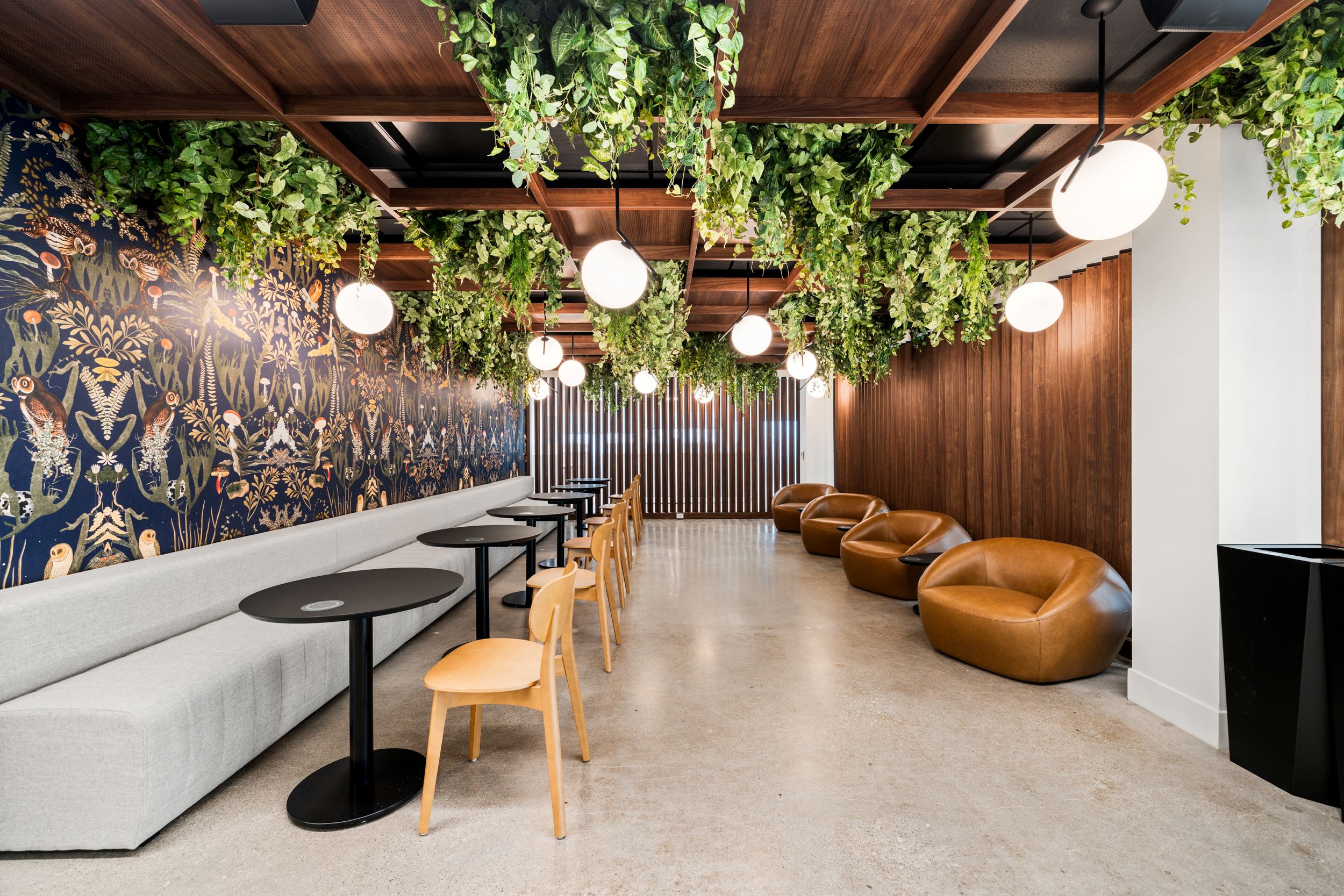
So I flipped the order of operations. Cafe 295 is not an amenity inside Jilani Place. It is the front door. Members walk in through a working cafe before they ever get to a desk. The coworking floor inherits the texture of the cafe instead of trying to fake it.
What this changes in practice
A few things change once the cafe is structurally first and the coworking is structurally second.
Cafe 295 is open to the public, not just members. That's deliberate. A coffee shop only has texture if real customers are in it, so we don't gate it. Members run into each other at the counter instead of the printer. They take informal client meetings in the booths without booking a meeting room or paying for boardroom time. They decompress between deep work blocks by ordering a coffee and watching the room for ten minutes, the way they used to at their old neighborhood spot. The coworking floor, meanwhile, stays quiet, because the social pressure release valve is twenty feet away.
I've spent most of my career on the commercial real estate side of the business, running Jilani Group. Most of what I learned in that work is that buildings get designed around floor plates, lease terms, and rentable square footage, and almost never around how a person actually feels walking through the door at 9 a.m. on a Tuesday. That gap, between how space gets built and how it gets used, is where Cafe 295 lives. It's a hospitality decision dressed up as a real estate one.
What I'd say to a remote employee thinking about this
If you've been working from coffee shops for a couple of years and you're tired of the tradeoffs, the move isn't to give up the thing you actually like. The point of building a workspace around a cafe instead of installing one inside an office is that you keep the texture and lose the friction. You can take the client call without going outside. You can plug in for a full day without the chair turning on you at hour three. You can host a meeting in a booth that looks and feels like a place a serious person works. And when you need a break, the cafe is still right there, with strangers and regulars and a door that keeps swinging open, doing what cafes do.
That's the version of remote work I wanted to build. Not a return to the office. Not a tolerance of the home office. Something else, designed from the cafe out.
Come work from the cafe side
If you want to see whether any of this lands the way I'm describing, the easiest test is to spend a day on the cafe side of the building. Our day passes include access to the coworking floor, but you don't have to use it. Sit at a cafe table. Take a call from a booth. See if the room does what I'm telling you it does. Then decide.
Fahad Jilani is the Founder of Jilani Place.